An outdoor heat pump unit mounted on a concrete pad in front of a two-story suburban house with a landscaped lawn.

Heat Pump Repair in Raymore, MO

Tell us about the job

Takes about a minute. No obligation.

RepairHeat PumpCass County, MO
Step 1 of 2

What ZIP code is the job in?

The air here works a heat pump hard

A heat pump in Cass County runs against a muggy summer and a cold winter, both pulling the system toward its limits. The dew point averages 66°F across June, July and August, which is heavy air for the outdoor unit to move heat against. Cass County has also seen 89 damaging wind events and 74 hail events between 2015 and 2024, and that outdoor unit sits outside through all of it.


That wear shows up as small problems first

A heat pump under this kind of strain tends to show trouble early: a capacitor that gives out sooner, a coil that takes a hit from hail, a connection that works loose from wind. Catching the real cause matters more here than in a milder climate, because the part that failed is rarely the only one that took the stress.

7 months
October through April, your system heats
5 months
May through September, it cools
24°F
the average winter night it heats against
87°F
the average summer afternoon it cools against
Isometric line illustration of a cutaway single-story house showing interior rooms, ceiling ductwork and an indoor air handler, connected by a line to an outdoor condenser unit on a pad beside the building.
Your system heats October through April and cools May through September.

NOAA nClimDiv, 1991–2020 normals

A heat pump in Cass County switches to heat in October and runs that way through April.

A weak part usually waits for that first cold stretch in October to fail.

A newer system is worth repairing, not replacing over a guess

Half the homes here were built by 1992
89 damaging wind events from 2015 to 2024
74 hail events from 2015 to 2024

Cass County logged 178 severe weather events between 2015 and 2024, and 89 of those were damaging wind. Hail showed up 74 times in the same stretch, and that outdoor unit has no way to get out of its path. A hail strike can bend the fins on the coil without stopping the system right away, so it keeps running while it loses efficiency. Wind throws branches and debris into the cabinet or loosens a connection behind the panel. None of that announces itself the way a dead unit does. If the outdoor unit has taken a hit from a storm, it's worth having someone look even while it's still blowing air.

Get the cause fixed, not just the symptom

Wind and hail are part of the reason a heat pump here wears faster than it should. When one acts up, the cause is often more than the one part that finally gave out. Have it looked at properly so the repair holds.

Find a contractor
A man in a dark cap, dark shirt and tan work pants walks up wooden steps toward a blue front door, carrying a worn canvas tool bag in his right hand, with a potted shrub beside the entry.
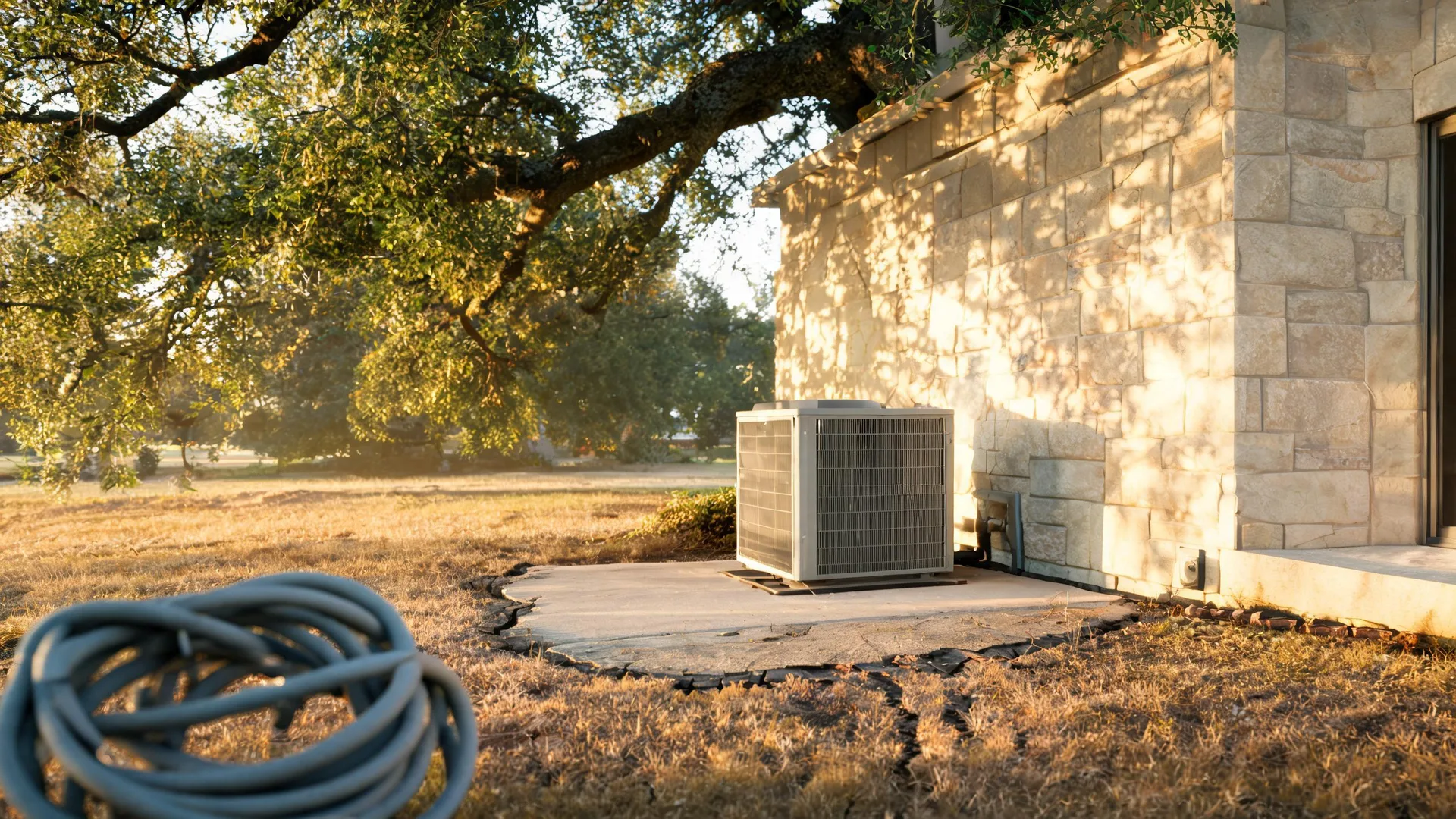
A gray heat pump outdoor unit mounted on a concrete pad next to the stone-accented exterior wall of a house.

A newer house often means a newer system

Half the homes in Cass County were built in 1992 or later. If yours came with a newer house, there's a good chance the system itself is newer too, and still has working life ahead of it. That matters when something breaks. A single failed part on a system with years left is usually a repair, not a reason to replace it. Check the install date if you have it, or ask whoever comes out to look. It changes what the right fix is.

Running it masks the warning signs

A heat pump with a weak part doesn't always stop. It compensates. A failing capacitor makes the compressor strain to start each cycle. A low charge makes the system run longer to reach the same temperature. The homeowner sees warm air or a longer runtime, not a shutdown, so the machine keeps getting asked to do the job while the strain on it builds.

One worn part pulls down the ones around it

The compressor is built to run with the right charge and a strong start from the capacitor. Take either away and the compressor draws more current and runs hotter than it should every time it cycles. Keep that up and the compressor is the part that fails for good, turning a repair into a replacement.

A few checks are safe to do before anyone comes out. Look at the thermostat first. Make sure it's set to heat or cool as needed and the batteries aren't dead, since a blank or frozen display sometimes isn't the heat pump at all. Check the air filter and swap it if it's gray or clogged, because restricted airflow makes the whole system work harder and can trip a safety switch. Walk outside and look at the unit itself. Clear away leaves, grass clippings or anything piled against the cabinet, since the outdoor unit needs open space around it to move air. If you see ice built up on the coil or the refrigerant lines, don't chip at it or run the system to try to force it off. That points to a problem worth having someone look at.

Storm damage on the outdoor unit doesn't always show up as a breakdown. Bent fins or a loosened connection can sit there for weeks while the heat pump keeps running, just worse than it should. If a storm has come through and you know the unit took hail or caught some flying debris, that's reason enough to have it looked at, even if the air coming out still feels fine. Catching a bent coil or a loose wire now is a smaller job than waiting for it to take out the compressor later.