






A gray outdoor heat pump unit with a circular fan grille sits on a concrete pad beside a dark wood-clad house, next to a gravel bed with ornamental grasses and a stepping-stone path.

Find a heat pump installation pro in Cape Girardeau County

When to replace a heat pump in Cape Girardeau, MO

A heat pump works harder here than in most places, cold winters and long muggy summers both ask a lot of it. At some point repairs stop making sense and replacement does. This page walks through the signs worth watching, your age, your bills, how often it's breaking down, so you can see where yours stands. Skip the search for a contractor, let one who knows these systems reach out to you instead.

Connect with a pro

Most heat pumps in Cape Girardeau last between 12 and 15 years, and that's the first number worth knowing. Yours runs double duty here, pulling heat out of cold winter air and pushing heat out of a house all through a long muggy summer, so the wear adds up faster than it does on a system that only has to do half the job. Past that age, a breakdown in January or July isn't a maybe, it's a when. Watch for the repairs getting more frequent, the outdoor unit running constantly without really catching up, ice building up on the coil in winter and not clearing on its own, or a bill that's climbed even though nothing about how you use the house has changed. Any one of those on a system already past 12 years is a sign the heat pump is losing the fight, not having a bad week. Once that's the pattern, a repair buys a little time; replacement is what actually solves it.

An older man with gray hair, a dark coat and scarf dusted with snow stands in a warmly lit entryway with an open wooden door, a table lamp, framed pictures, and a plant in a vase.
An older man with gray hair and a beard wearing a dark snow-dusted coat stands in a home entryway, with a lamp-lit living room and a wooden staircase behind him.
An older man with gray hair and a beard, wearing a dark snow-dusted coat, stands in a warmly lit home entryway with a hallway, console table with lamp, patterned rug, and living room visible behind him.
A gray-haired bearded man in a dark snow-dusted coat and scarf stands inside a dimly lit home entryway, with a hallway, framed picture, lit table lamp and staircase behind him.

A heat pump doesn't make heat, it moves it. In January it pulls what warmth exists in cold outdoor air and concentrates it inside your house. That's a harder job than running a furnace, and it leans on parts most homeowners never think about. The reversing valve is what lets one unit heat in winter and cool in summer, and years of switching back and forth wear it down. When the outdoor coil ices over in cold weather, the system runs a defrost cycle, kicking into cooling mode for a few minutes before switching back, which is normal until it starts happening too often. A compressor that's losing strength can't keep up on the coldest days, so the backup electric heat strips carry more of the load than they should, and your bill shows it. Lost refrigerant or a corroded coil means longer run times for the same result. And a unit near the end tends to short cycle, turning on and off in bursts rather than settling into a steady run.

How a heat pump actually fails

  • A heat pump moves heat instead of burning fuel, so in January it pulls what little warmth is in 30 degree air and concentrates it to heat your house.
  • That reversing valve is what lets the same unit switch from heating in winter to cooling in summer, and it's one of the first parts to fail after years of constant switching.
  • Below about 25 to 30 degrees the outdoor coil can ice over, so the unit runs a defrost cycle that briefly reverses itself and blows cool air before switching back.
  • An aging compressor loses its ability to reach full capacity on the coldest days, which is why some older units lean hard on backup electric heat strips all winter.
  • Every degree of lost refrigerant charge or every bit of coil corrosion makes the compressor work longer to hit the same temperature, raising the electric bill even on a system that still runs.
  • A unit nearing the end of its life often short cycles, turning on and off in quick bursts instead of running a full, efficient cycle.
A gray outdoor condenser unit on a concrete pad beside a beige vinyl-sided house, with a wall-mounted disconnect box, flexible conduit, mulch bed, shrubs and a concrete walkway in front.
A unit like this one, clean grille, clear pad, nothing piled against it, can still be worth repairing if it's within its years and the fix is small.
A weathered gray outdoor condenser unit on a concrete pad beside a house with horizontal vinyl siding, with conduit, refrigerant lines, and an electrical disconnect box on the wall behind it.
Grime caked on the grille and leaves banked against the base mean the unit is working against itself, pulling less air and running longer to do the same job.
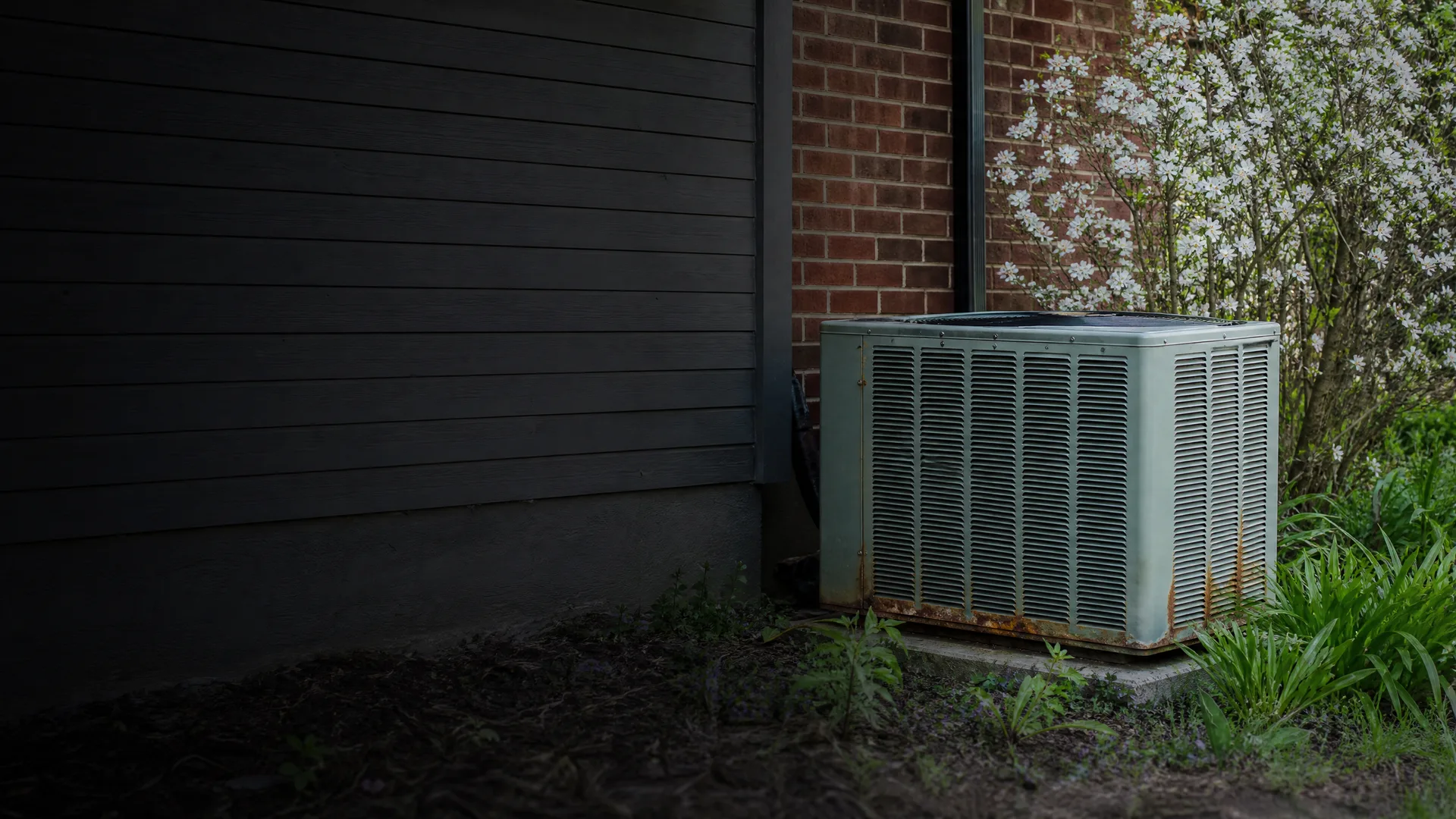
An outdoor air conditioning condenser unit on a concrete pad beside a dark horizontal-siding wall and a brick wall, with flowering shrubs and grass nearby.

You go out to check the unit on a clear March afternoon, the ground still soft from the last thaw. Rust runs along the base of the cabinet, flaking where the metal meets the pad. The grille looks fine, the fan spins when it kicks on, but that rust line wasn't there last spring. You crouch down and press a thumb against it and a piece comes away. Cape Girardeau winters put a lot of hours on this thing, and somewhere in the cabinet, parts have been sitting damp through all of it. You straighten up, brush your hands off, and figure it's worth having someone look before summer asks anything more of it.

The right pro for this job

A heat pump near the end of its years doesn't always fail outright. It runs longer to hold the same temperature, the compressor cycles more, and the bill climbs a little more each winter without anything breaking outright. That's the point where paying for another repair stops making sense against the cost of a new unit, especially once yours is past 12 years and into the stretch where parts for it get harder to source. Working that out on your own means getting a contractor out to look at the unit, waiting on a diagnosis, then calling around for a second opinion and a quote to compare it against, all while the unit keeps struggling through whatever the season is doing outside. Handing that off means one contractor who knows heat pumps in this climate looks at your specific system, your age, your repair history, and tells you straight whether it's worth fixing or time to replace it.

What age alone tells you

A heat pump at 13 or 14 years hasn't failed, and it might run another winter without trouble. But the compressor has pulled heat out of cold air and pushed it out of the house for that whole time, and the parts inside wear on that same schedule whether or not anything has broken yet. Age doesn't predict the next repair. It tells you how much life is left to spend a repair bill on. A $600 fix on a 4 year old unit and the same fix on a 14 year old unit are not the same decision.


What a repair bill tells you

A repair bill is a single data point, not the whole picture. One $200 capacitor on an otherwise sound unit is nothing to act on. A string of calls over two winters, each one a different part, points at a unit that is wearing out generally rather than failing once. Add up what's gone into it over the last year or two before you decide. If that total is climbing toward what a new unit costs installed, the math has already answered the question, whether or not this particular repair looks small.

Why does your heat pump run so hard here?

  • Winter nights average 27°F

    Winter nights average 27°F, so your heat pump is pulling heat from cold air most nights, not mild ones.

  • Heat runs October through April

    Heat runs October through April. That's seven months of the compressor working, not the two or three some places get.

  • Cooling runs May through September

    Cooling runs May through September. Add that to the winter months and the unit barely gets a season off.

NOAA nClimDiv 1991-2020

An outdoor air conditioning condenser unit with a top fan grille sits on a concrete pad beside a house with horizontal siding and a concrete step.
Before you get your heat pump installation
A gray outdoor condenser unit on a concrete pad beside a house with horizontal lap siding, a conduit and disconnect box on the wall, a shrub with white flowers at right and evergreen foliage at left.
After you get your heat pump installation

You call for a repair on a unit that's 11 years old and running fine otherwise. One bad part, a fair price, and it carries you through another Cape Girardeau winter without a fight.

You call for the same repair on a unit that's 14 years old and already running longer than it used to. The part gets fixed, but the compressor is still worn, and the next call comes sooner than you'd like.

Power here costs 13.01 cents per kilowatt-hour

At 13.01 cents per kilowatt-hour, a heat pump that's losing efficiency costs you more every month it keeps running that way. An older unit cycling longer to hold the same temperature doesn't just wear out, it shows up on the bill first.

EIA-861 2025

Where that leaves you

  • A heat pump past 12 to 15 years that's cycling longer and costing more each month is one worth replacing rather than repairing again.
  • Rust at the base, a compressor working overtime, and bills that climb each winter are the signs this page has walked through.
  • Age alone doesn't decide it, but age combined with rising repair costs and falling efficiency usually does.
  • Skip calling around to different contractors, explaining the same history each time, and sorting through quotes on your own.
  • A unit still running fine at 11 years is a different case than one limping through its 14th winter, and the right call depends on which one is yours.
  • Matching with a contractor who knows Cape Girardeau winters and summers means getting a straight answer on your specific unit, not a guess.

You've seen the signs by now. A unit between 12 and 15 years old that's cycling longer, running up the bill each winter, maybe showing rust at the base, is one that's earned a hard look rather than another repair. None of that happens on its own. Age by itself doesn't tell you to replace a heat pump that's otherwise sound, and a unit at 11 years with one bad part isn't the same case as one limping through its 14th winter in Cape Girardeau. What tells you is the combination: the years on it, what repairs have started costing, and whether it's working harder than it used to just to hold a temperature. If you've read through the bills and the history and you're still not sure which case is yours, that's a fair place to be. The part of this that takes real time is usually everything after you decide to act. Calling a few contractors, explaining the unit's age and history to each one, waiting on separate quotes and trying to compare them against each other. That work goes away here. Instead you get matched with a contractor who works on heat pumps in this county, who knows what a Cape Girardeau winter asks of a compressor and what a long summer does to one, and who can tell you straight whether yours is worth fixing again or worth replacing. You end up with an answer specific to your unit, not a guess.

A gray outdoor heat pump unit mounted on a concrete pad beside a dark horizontal-slat clad house wall, with gravel ground and shrubs nearby.

Matched to your heat pump job

New system or replacementHeat PumpCape Girardeau County, MO
Step 1 of 2

What ZIP code is the job in?
