A illuminated two-story red brick house on a quiet residential street at dusk, flanked by mature trees under a deep blue evening sky.

Heat Pump Repair in Monett, MO

Tell us about the job

Takes about a minute. No obligation.

RepairHeat PumpBarry County, MO
Step 1 of 2

What ZIP code is the job in?

Barry County sees its share of storms

Barry County recorded 248 severe weather events between 2015 and 2024, including 121 damaging wind events, 100 hail events, and 15 tornadoes. A heat pump's outdoor unit sits outside through all of it, with no wall to protect the coil or fan.


A unit that still runs can still be hurt

Hail can bend the fins on the outdoor coil and wind can drive debris into the fan without stopping the system outright. A heat pump that still turns on after a storm is worth having checked anyway, since damage to the coil or fan often shows up later as a harder-working, less efficient unit.

7 months
October through April, your system heats
4 months
June through September, it cools
27°F
the average winter night it heats against
87°F
the average summer afternoon it cools against
Isometric line illustration of a cutaway house showing interior rooms, an air handler with ductwork in the attic space, and an outdoor condenser unit beside the exterior wall.
Your system heats October through April and cools June through September.

NOAA nClimDiv, 1991–2020 normals

Monett summers run muggy, with the dew point near 65 degrees all through June, July and August.

A heat pump moving that much moisture out of the air all summer is a heat pump working hard, and hardworking parts wear down sooner.

Half the homes here were built in 1986 or later, so the heat pump in one of them is usually worth fixing

Half the homes here were built by 1986
121 damaging wind events from 2015 to 2024
100 hail events from 2015 to 2024

October is when heat starts running here, and that first cold snap is when a weak part gets found out. A heat pump that struggled at the end of last winter doesn't fix itself sitting idle through the summer. The defrost board, the reversing valve, a low refrigerant charge, whatever was marginal in April is still marginal now, and it has to carry the house through seven months of heat, October clear through to the end of April. Overnight lows here average 27°F across December, January and February, so a unit that's already working harder than it should won't have much left when it matters most. Getting it looked at before October, rather than after the first hard freeze, is the difference between a repair and a system that quits in January.

A heat pump that came through a storm still running is worth a second look

If the outdoor unit took hail or wind damage in a recent storm, have it checked even though it still runs. Bent fins on the coil or a fan that took on debris won't always stop the system, but they make it work harder until something gives. Getting it looked at now catches that before the cold sets in.

Find a contractor
A gray air-source heat pump mounted on a concrete pad next to a house with gray vinyl siding, surrounded by gravel and flanked by green shrubs and white hydrangea flowers.

Know the age before you decide anything

Find the age of the system before you decide anything about repair. Check the nameplate on the outdoor unit, or whatever paperwork came with the house if the heat pump is original to it. A system that's had less than half its working life behind it is a system worth fixing when something goes wrong, a bad capacitor, a stuck reversing valve, a refrigerant leak. None of those are reasons to replace a unit that still has years in it. Have the install date ready when someone comes out to look at it.

Listen for what changed

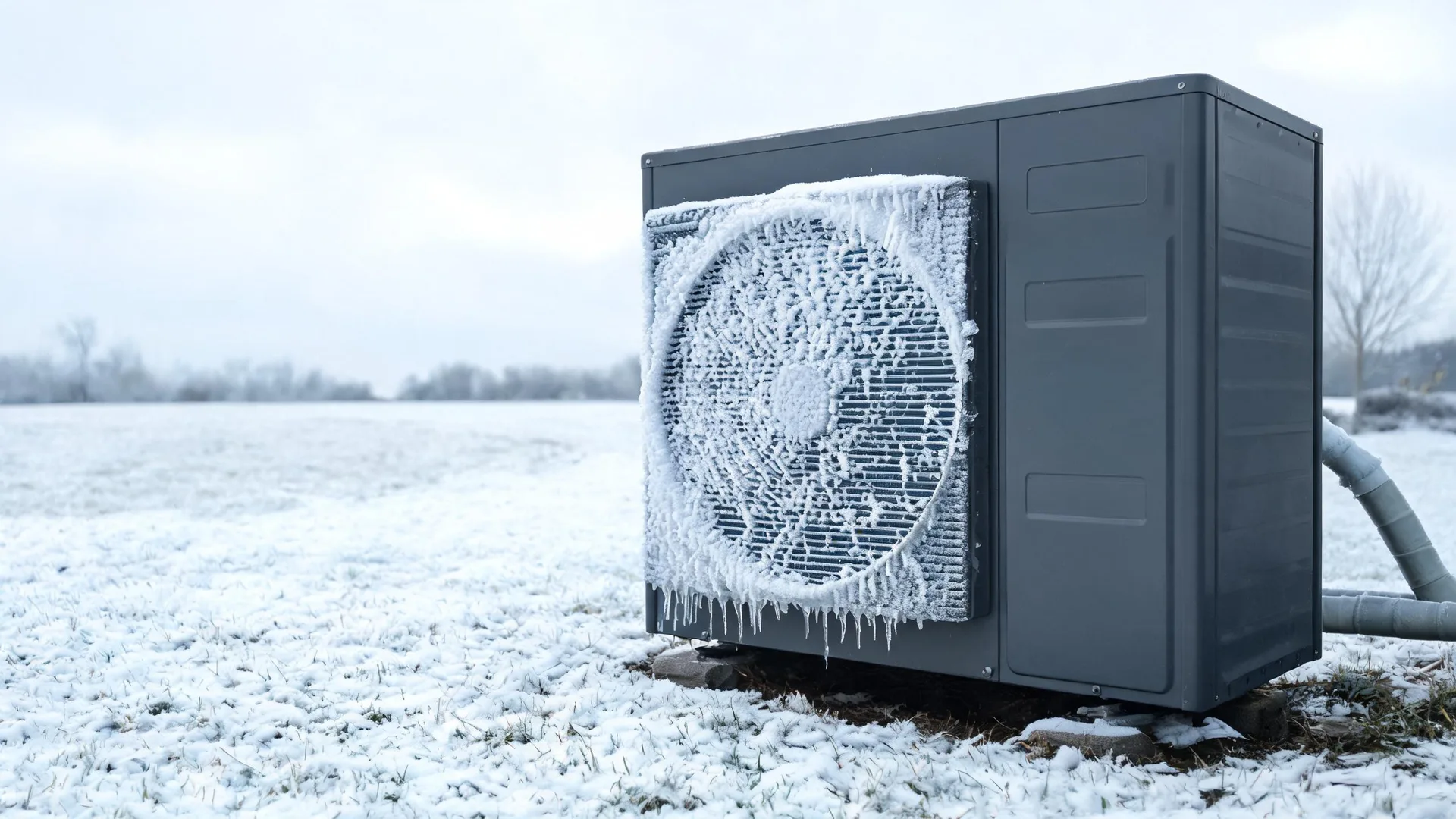
A heat pump in trouble usually says so before it quits. Short cycling, where it kicks on and off every few minutes instead of running a steady stretch, points to a bad sensor or a refrigerant problem. Ice building up on the outdoor coil and not clearing during defrost means the defrost board or reversing valve isn't doing its job. Air coming out of the vents that feels barely warm, or blows cold in heating mode, often traces back to the reversing valve stuck in the wrong position. A grinding or screeching from the outdoor unit is a motor bearing giving out.

Running longer is still a sign

Not every problem announces itself with a strange noise. A heat pump that runs longer than it used to, or never seems to catch up to the thermostat setting, is losing capacity somewhere, often a slow refrigerant leak or a coil that's lost its ability to transfer heat. Higher humidity indoors during summer than the system used to leave behind is the same kind of sign. None of this means the unit is done. It means something inside it is working harder to do what it used to do easily, and that's worth having a tech trace to the actual part before it fails outright.

A heat pump losing refrigerant doesn't stay a small leak. The compressor depends on refrigerant to carry heat and to keep itself cool while it runs, and a low charge makes it work harder and run hotter with every cycle. Ice on the outdoor coil behaves the same way. Left alone it spreads, blocks more airflow, and forces the system to run longer to make up for it, which only builds more ice. A reversing valve stuck halfway doesn't fix itself by running more hours, it just means more of those hours are wasted. The common thread is that a part already under strain keeps taking damage every time the system cycles, where catching it early is a repair and catching it late is a compressor.

Storms are part of what this system has to survive here, not just summer humidity. Wind drives debris into the outdoor fan, hail bends the coil fins, and the unit has no choice but to sit outside and take it. A compressor that keeps running after a hit like that is still a compressor working against bent fins or a damaged fan blade, and it doesn't announce that strain the way a dead system would. That's a different kind of wear than a hot summer puts on a unit, and it's worth naming separately when a tech comes to look at it. If the outdoor unit has been through wind or hail recently, say so when you call, even if nothing seems wrong yet.