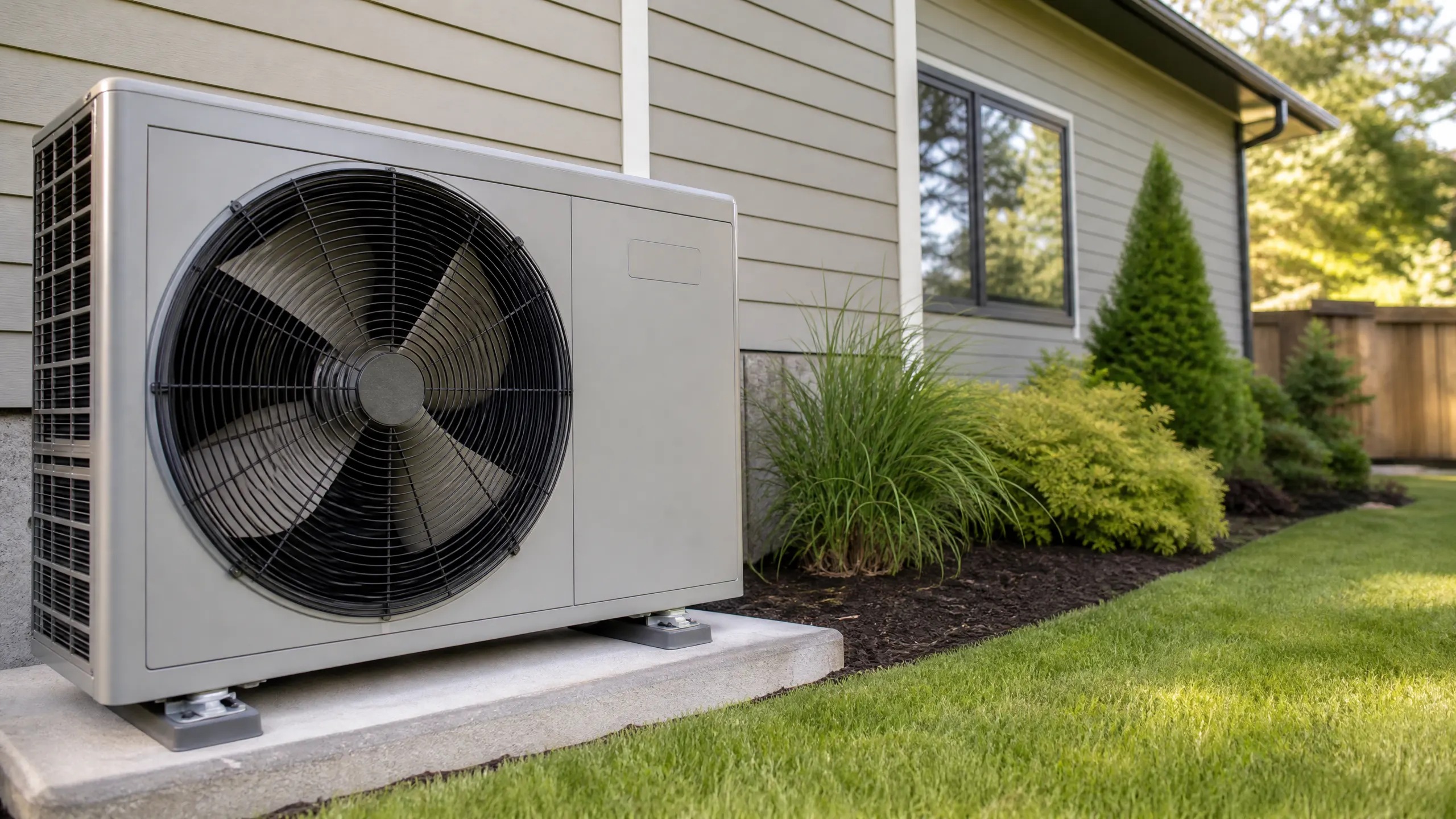





An outdoor heat pump unit mounted on a concrete pad beside a house with beige siding and a landscaped garden bed.

Heat Pump Repair in Eldon, MO

Tell us about the job

Takes about a minute. No obligation.

RepairHeat PumpMiller County, MO
Step 1 of 2

What ZIP code is the job in?

Most heat pump failures trace back to the reversing valve or the defrost cycle. The reversing valve is what switches the system between heating and cooling, and when it sticks, you'll feel air that's the wrong temperature or a unit that won't switch modes at all. The defrost system is the other common culprit. A heat pump has to melt off the frost that builds on its outdoor coil in cold weather, and it does this by briefly reversing itself and running a small heater. If the defrost sensor or control board fails, ice just keeps building on the coil until the unit can't pull in enough air to work. You'll see this as a system that runs but puts out weak heat, or an outdoor unit caked in ice that never clears. Low refrigerant charge from a slow leak causes the same kind of weak performance, just without the ice. Any of these are worth a look as soon as you notice them, since a frozen coil or a flooded compressor only gets harder to fix the longer it runs that way.

7 months
October through April, your system heats
5 months
May through September, it cools
26°F
the average winter night it heats against
87°F
the average summer afternoon it cools against
Isometric grayscale illustration of a cutaway house showing interior rooms, ductwork and an indoor air handler connected by lines to an outdoor condenser unit on the ground outside.
Your system heats October through April and cools May through September.

NOAA nClimDiv, 1991–2020 normals

Miller County asks real work of a heat pump, cold enough winters and humid enough summers to use both sides of the system.

A heat pump built for that job doesn't fail because of it. When one acts up here, it's still the reversing valve, the defrost control, or a slow leak.

Eldon doesn't ask anything extra of a heat pump, so the fix is the same one

Power costs 12.91 cents a kWh statewide
Climate zone 4A
Cooling runs May through September

Half the homes in Miller County were built in 1985 or later. If that includes yours, the heat pump itself is probably not the problem, just a part inside it. A reversing valve or defrost control failing doesn't mean the system is wearing out. It means that one part needs attention. Worth finding out whether your home falls on the newer side before you decide anything about replacing it.

Fix the part that failed, not the whole system

A stuck reversing valve or a failed defrost control is a repair, not a reason to replace a system that's still within its working life. Get the part diagnosed before you plan around a new unit.

Find a contractor
A white mini-split heat pump outdoor unit mounted on a concrete pad beside a gray-sided house, surrounded by gravel and green shrubs.

The diagnosis is quick once the gauges go on

A tech starts by watching the system run before touching anything. Set it to call for heat and watch the outdoor unit. The fan should spin right away. The reversing valve should click over without hesitation. Gauges go on next, one on the high side and one on the low side, and that reading alone usually points toward a leak, a stuck valve, or a defrost problem before anything gets taken apart. A multimeter on the defrost control board shows whether the sensor is reading coil temperature correctly and whether the board calls for defrost when it should. A valve that's actually switching will click and the line temperatures will swap. One that's stuck stays quiet and the lines stay the same. Each of these problems shows up as a different pressure reading and a different pattern on the coil, so once the gauges are on there's not much guessing left to do.

What you can look at outside

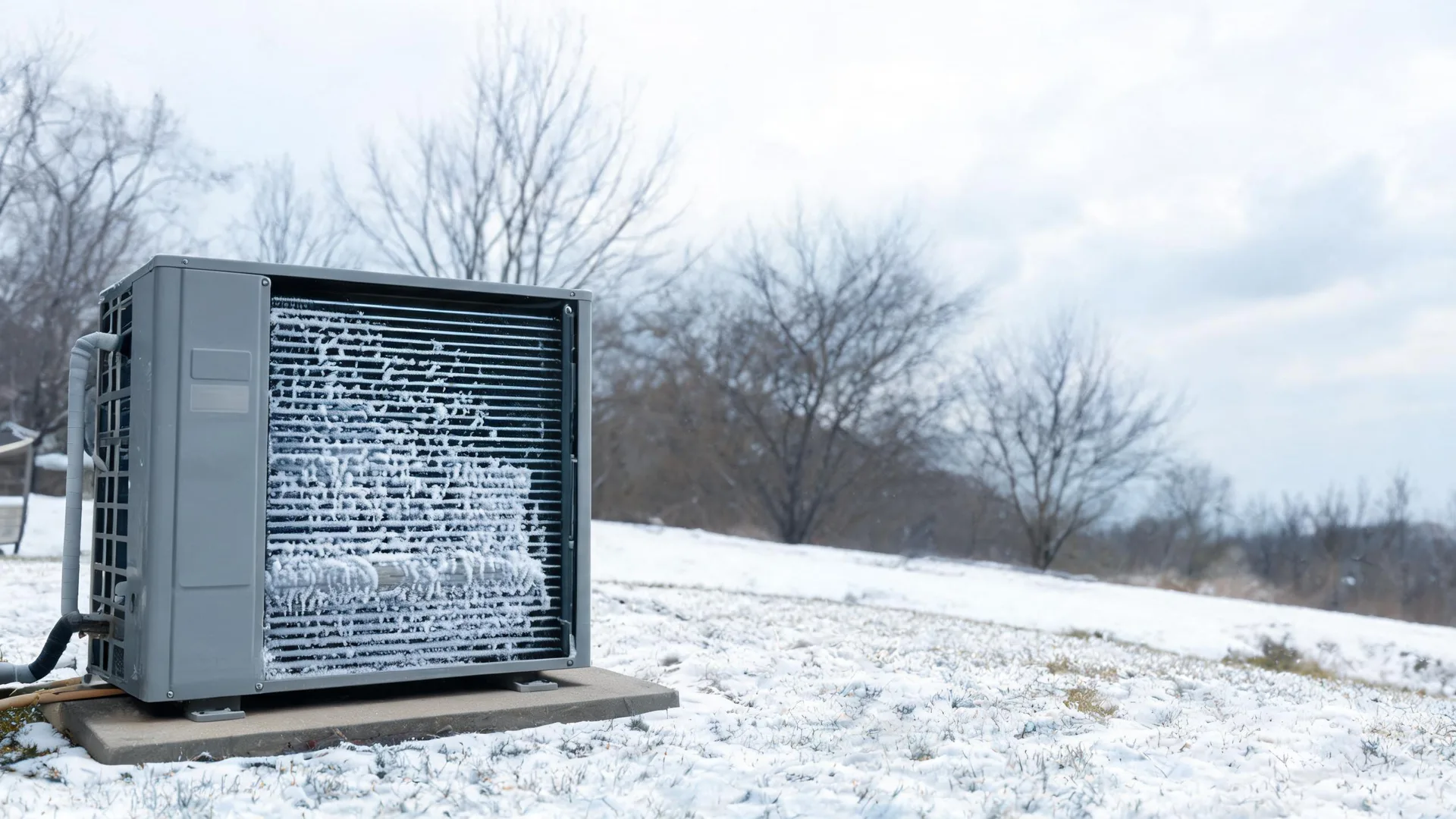
Check that the outdoor unit has clear airflow on all sides and nothing stacked on top of it. Look at the coil for a heavy, even coat of ice rather than a light frost. A light frost is normal in cold weather and clears on its own during the defrost cycle. If the outdoor fan isn't spinning at all while the indoor system is calling for heat, that's worth noting for whoever comes out.
What you can check inside

Replace the air filter if it looks dirty. A clogged filter restricts airflow and can mimic a failing part, so it's worth ruling out first. Make sure the thermostat is set to heat and the set temperature is actually above the room temperature. Feel the air coming out of the vents. Cool or lukewarm air instead of warm points toward the reversing valve rather than the filter or thermostat.

A stuck reversing valve or a failing defrost board doesn't ruin a heat pump in one afternoon. It wears it down one cycle at a time. Ice left on the coil blocks airflow, so the system has to work harder to move the same amount of air across it, and that extra strain falls on the compressor. A valve that won't seat right can let refrigerant flood back into the compressor, and a compressor that floods repeatedly wears in a way it doesn't recover from. A coil that never fully clears during defrost loses a little more capacity each cycle, until the unit is running nearly nonstop just to fall short of the set temperature. None of this corrects itself by leaving it alone. The part acting up now is the one that's easy to replace. The compressor it's slowly damaging is not.

A compressor failing from age is a different conversation than a reversing valve sticking. Age-related failure spreads out. Parts fail one after another over a few years because they're all the same age and wearing on the same schedule. A valve or a defrost board failing on its own, with the compressor still sound, is just a part reaching the end of its life ahead of the rest. Replacing a whole heat pump over one bad part is like replacing a car because the alternator died. The question worth asking is whether anything else has failed recently, not whether this part failing means the system is done.