






A row of dark-painted single-story houses with gabled shingle roofs behind a trimmed hedge and mown lawn, surrounded by large leafy trees under an overcast sky.

Heat Pump Repair in Dexter, MO

Tell us about the job

Takes about a minute. No obligation.

RepairHeat PumpStoddard County, MO
Step 1 of 2

What ZIP code is the job in?

A heat pump in Stoddard County earns its keep both directions. Summer air here sits heavy, with the dew point averaging 68°F across June, July and August, which is higher than most of the country sees. That moisture means the system runs longer each cycle to pull comfort out of the air, not just heat. Then there's the wind. Stoddard County has taken damaging wind 110 times between 2015 and 2024, and a heat pump's outdoor unit sits right in the path of that, exposed to debris and strain a furnace never deals with. Between the humidity and the weather, parts wear down faster here than the manual assumes. When something starts acting up, it's worth finding out exactly what gave out and why before deciding what to do about it.

7 months
October through April, your system heats
5 months
May through September, it cools
29°F
the average winter night it heats against
89°F
the average summer afternoon it cools against
Isometric line illustration of a cutaway single-story building showing interior rooms, ceiling ductwork, an indoor air handler, and an outdoor condenser unit connected by refrigerant lines.
Your system heats October through April and cools May through September.

NOAA nClimDiv, 1991–2020 normals

Heat pumps here switch over to heating by October and stay on cooling into September.

A weak part usually waits until the first real cold snap or the first hot week to quit.

This county takes a beating from the weather, and the outdoor unit stands right in it

143 severe weather events from 2015 to 2024
19% of homes statewide lost power a day or more in 2024
110 damaging wind events from 2015 to 2024

If the outdoor unit took a hit this year, hail, a branch, flying debris, it's worth having someone look at the coil and the fan blade even if the system seems to be running fine. Bent fins and a nicked blade don't always stop a heat pump from working, but they make it work harder, and that's wear you won't see from the thermostat. A technician can check the refrigerant lines and the cabinet for damage that isn't obvious from across the yard. Thirteen hail events and 110 damaging wind events hit this county between 2015 and 2024, so this isn't a rare ask around here. Catching a dented coil or a cracked line now costs less than waiting for it to fail when you need the system most.

A hard-working system deserves a real diagnosis

Your heat pump has been doing double duty against this county's weather all year. When it starts acting up, that's usually wear catching up with it, not bad luck. Get the actual cause checked before deciding what to fix.

Find a contractor
A man in a gray T-shirt and tan work pants, seen from behind, carries a worn canvas tool bag up concrete steps toward a blue front door of a house with gray siding and a potted shrub.
A white mini-split heat pump outdoor unit mounted on a concrete pad beside a gray-sided house, surrounded by gravel and green shrubs.

Small Signs Come Before Big Failures

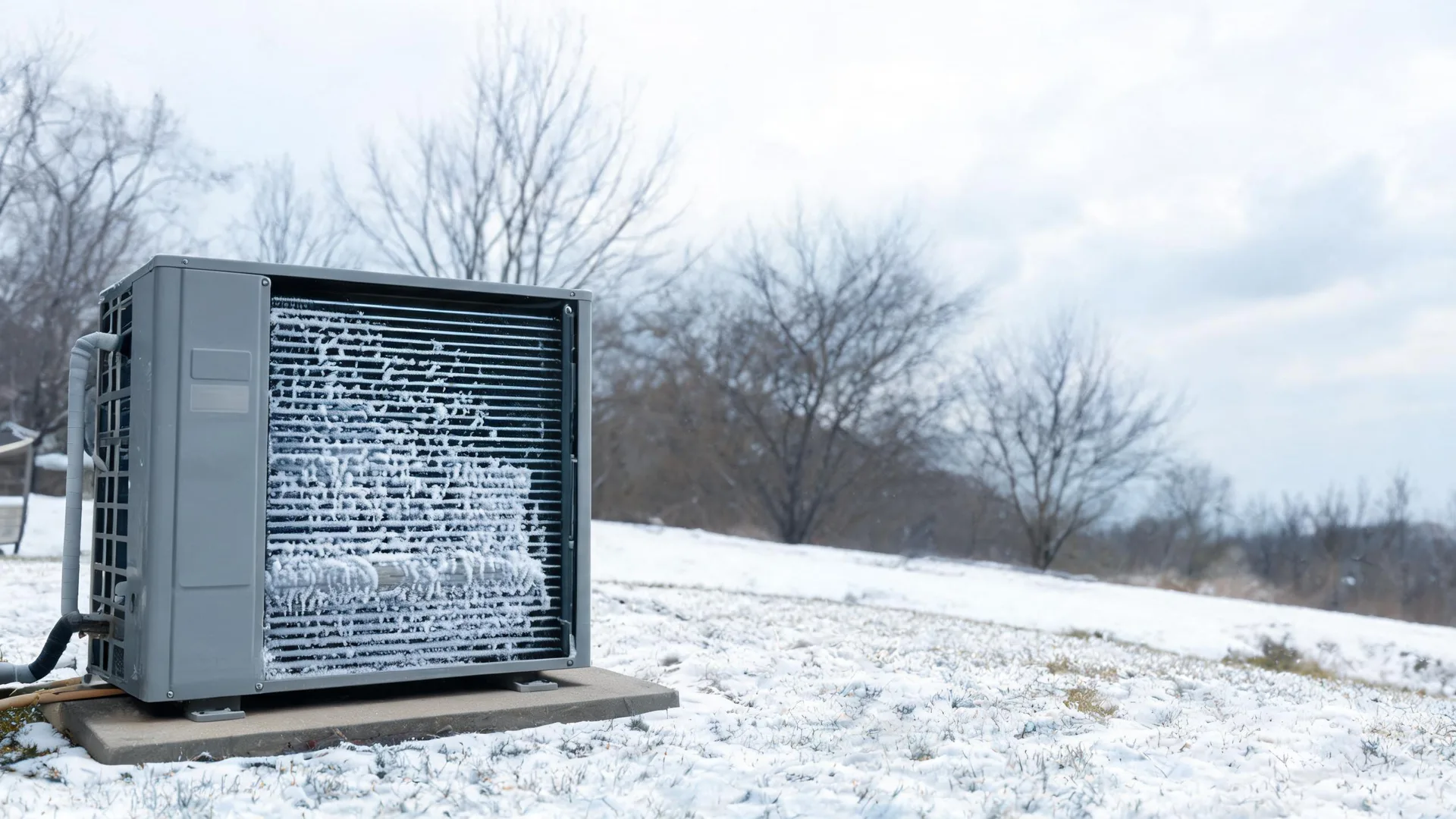
A heat pump doesn't give you one big failure most of the time. It gives you small ones first. The air coming out feels lukewarm instead of hot, or the system runs long cycles without catching up to the thermostat setting. You hear the outdoor unit click and try to start, then stop, click and try again. Ice builds up on the outdoor coil and doesn't clear during the defrost cycle like it should. The reversing valve sticks, so you ask for heat and get cold air, or the other way around. A hissing or bubbling sound near the lines usually means refrigerant is escaping somewhere it shouldn't. None of these mean the whole system is done. A weak capacitor can make the outdoor fan struggle to start. A failing defrost control board can leave frost sitting on the coil until airflow stops almost completely. Worn contactor points cause the short-cycling. Each of these is a part a technician can test and replace on its own. What matters is not waiting once you notice it, because a motor straining against a bad capacitor wears out faster, and a coil that stays iced over loses efficiency every hour it runs that way.

A small fault spreads to parts that were fine

A failing part rarely stays contained. A stuck reversing valve forces the compressor to push against pressure it wasn't built for. Frost left on the outdoor coil blocks airflow, so the compressor runs hotter than it should every cycle. The compressor is the most expensive part in the system, and it's usually the last to fail because something smaller let it absorb damage for weeks first.
Running it while it struggles costs the fix itself

Shutting the system off when something is clearly wrong is cheap insurance. A technician can often replace a capacitor, a contactor or a control board on its own and leave the rest of the system untouched. Keep running a unit with one of those failing and the strain spreads to the motor or the compressor, and now the job is bigger than the part that started it.

Most heat pump failures start with something small that does one job and does it badly. A capacitor weakens and can't give the compressor or fan motor the jolt it needs to start, so the unit hums and stalls instead of kicking on. A contactor pits and sticks from years of opening and closing, and the outside unit either won't start or won't shut off. Sensors drift out of calibration and tell the defrost board the coil is warm when it's actually iced over. Fan motors wear out from bearing failure, the same as any motor that runs for years without being replaced. None of these start out as compressor problems, but left alone, that's where they end up, because the compressor is what absorbs the strain when something upstream of it is failing.

A diagnostic visit starts outside, at the unit itself, before any panel comes off. A technician checks refrigerant pressure on both the high and low side, because a system low on charge behaves differently than one with a failing compressor, even though both can feel the same from the thermostat. Electrical testing comes next: the capacitor gets checked under load, not just by looks, since a capacitor can read fine sitting still and still fail to start a motor. The contactor points get inspected for pitting. If frost or ice is involved, the defrost board and its sensors get tested to see whether the system is actually sensing coil temperature correctly or just guessing. None of this requires guesswork on the technician's part. Heat pumps fail in patterns, and a gauge set and a multimeter tell you which pattern you're looking at before a single part gets replaced.