A row of dark-sided houses with brown shingled gable roofs behind tall trimmed hedges, with a mowed lawn in the foreground and overhanging tree branches against an overcast sky.

Heat Pump Repair in Sikeston, MO

Tell us about the job

Takes about a minute. No obligation.

RepairHeat PumpScott County, MO
Step 1 of 2

What ZIP code is the job in?

The heat pump runs in both directions here

A heat pump in Sikeston works through long, muggy summers and real cold in winter, with no season off. The dew point averages 68°F across June, July and August, which is higher than most of the country sees. Heavy air like that makes the system run longer to pull moisture out, and it does that on top of whatever heating it already handled months earlier.

What that means when something breaks

A system that runs this much wears its parts sooner than one running in a milder climate. Scott County has also seen damaging wind 112 times between 2015 and 2024, and wind events can knock around an outdoor unit or cut power in ways that stress it further. When a heat pump here starts acting up, it's worth finding the actual cause rather than guessing, since a repair that misses the real problem won't hold up long under this kind of use.

7 months
October through April, your system heats
5 months
May through September, it cools
29°F
the average winter night it heats against
88°F
the average summer afternoon it cools against
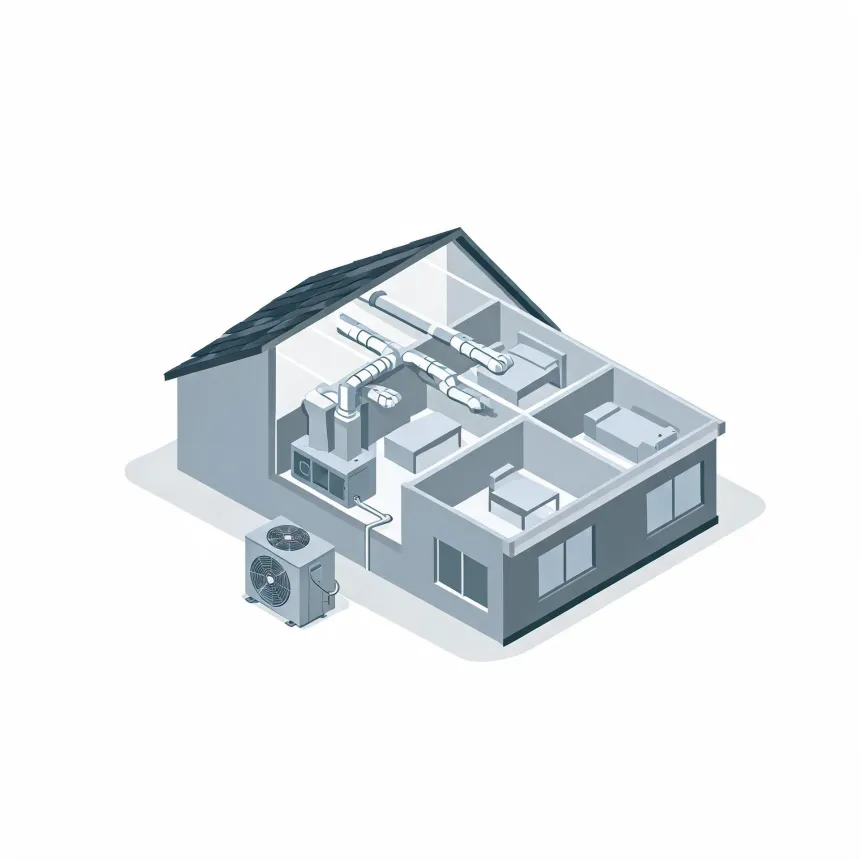
Isometric grayscale illustration of a cutaway house showing interior rooms, ceiling ductwork connected to an indoor air handler, and an outdoor condenser unit beside the exterior wall.
Your system heats October through April and cools May through September.

NOAA nClimDiv, 1991–2020 normals

A heat pump that won't switch out of one mode is stuck, not confused.

If it's blowing cold air in heating mode, the reversing valve is a likely place to start looking.

Scott County sees 144 severe weather events a decade. The outdoor unit sits outside for all of them.

144 severe weather events from 2015 to 2024
19% of homes statewide lost power a day or more in 2024
112 damaging wind events from 2015 to 2024
The first cold snap finds the weak partHeat here switches on in October, after the unit already put in a full summer.

If a storm came through recently, it's worth looking at the outdoor unit before writing off whatever it's doing as normal wear. Hail dents the fins on the coil, and bent fins choke the airflow the system needs to move heat in or out. Wind-blown branches and debris do similar damage, and a unit can take a hit without stopping. It keeps running, just worse, and the strain shows up as a bigger bill or a shorter life for the compressor. Scott County has logged 12 hail events and 112 damaging wind events between 2015 and 2024, so this isn't a rare thing to check for. A technician can look the unit over for bent fins, a cracked fan blade or a cabinet knocked out of square, even if it's still blowing air right now.

A hard-working system is still the likely cause

Whatever your heat pump is doing right now, it has earned the right to be tired. Have it looked at before you decide it needs replacing instead of fixing. A technician can tell you which part gave out and why, so the repair actually holds.

Find a contractor
A white mini-split heat pump outdoor unit mounted on a concrete pad beside a gray-sided house, surrounded by gravel and green shrubs.

What to check before the call

Before anyone comes out, there are a few things worth checking yourself. Look at the thermostat first. Make sure it's set to heat or cool as intended and the temperature is actually set past where the room is sitting. A dead thermostat battery can look like a dead system. Next, check the outdoor unit. If snow, leaves or anything else is packed around it, the system can't move air through the coil and will struggle or shut down trying to protect itself. Go inside and pull the air filter. If it's gray and clogged, swap it, since a blocked filter chokes airflow the same way a buried outdoor unit does, and it can cause the whole system to ice up or trip off. Check the breaker panel too. A heat pump that won't start at all sometimes just needs a tripped breaker reset, though if it trips again right away, stop and leave it off. Last, look at the outdoor unit for ice. Some frost in the cold months is normal and clears itself during a defrost cycle, but a coil that's fully iced over or stays frozen for hours points to a real problem underneath. None of this tells you exactly what's wrong, but it rules out the easy stuff before anyone has to take the system apart.

The compressor is the part that ends the system's life

Most heat pump compressors fail from something smaller going wrong first. Low refrigerant charge makes a compressor run hotter than it should, and running hot year after year breaks it down from the inside. A failing capacitor makes the compressor struggle to start, and that strain adds up the same way. By the time the compressor itself quits, it's usually the last part to go, not the first.

The reversing valve and defrost parts fail from constant switching

A heat pump asks more of a few parts than a straight AC or furnace ever does. The reversing valve shifts the system between heating and cooling, and every shift is a chance for it to stick. The defrost board and sensor tell the system when to melt frost off the outdoor coil, and if that sensor reads wrong, the coil either ices over or the system defrosts when it doesn't need to. These parts cycle more than almost anything else in the system, and that's exactly why they tend to wear out first.

A refrigerant leak or a weak run capacitor doesn't stop the system. It keeps trying, and that's the problem. A low charge makes the compressor run hotter than it's built for, and every hour it keeps running on that low charge adds to the damage. A capacitor that's starting to go makes the compressor struggle on every start instead of failing clean, and each hard start wears it down a little more. Ice on the outdoor coil is the same story. The system will keep pulling in air through a coil that's choked with frost rather than shutting itself down, and that starves the compressor of the airflow it needs to work properly. The parts built to protect the system can only do so much once something is already failing. Turning it off until someone can look at it costs you comfort for a day. Leaving it running can turn a part worth repairing into one that has to be replaced.

A repair is worth doing when the part that failed is the only thing wrong. A bad capacitor, a stuck contactor, a failed sensor, these are single points of failure, and swapping the one part brings back a system that runs the way it used to. Replacement starts to make more sense when the compressor itself is the problem, since that part is expensive enough on its own to change the math, and more sense again when the system is old enough that other parts are likely to fail soon after this one gets fixed. Age matters less by itself than what else has already gone wrong. A system that's needed two or three repairs in the last couple years is telling you something a single repair bill won't. Ask what failed and why before deciding which way to go, since a technician who can answer that is giving you something to actually decide with.