




A row of dark-clad houses with gray gabled roofs behind trimmed hedges and a lawn, framed by overhanging tree branches under an overcast sky.

Heat Pump Repair in Jefferson City, MO

Tell us about the job

Takes about a minute. No obligation.

RepairHeat PumpCole County, MO
Step 1 of 2

What ZIP code is the job in?

A heat pump in Cole County switches into heating mode around October and stays there through April. The first cold snap is when a weak part finally gets tested, so repair calls tend to cluster in those early weeks. If yours is struggling to keep up or running constantly without warming the house, that's usually a sign something was already wearing down before the season started. The same thing happens in May, when the switch to cooling puts a different strain on the system. Either way, the fix is finding what's actually failing, not just getting the house back to temperature for a day or two.

7 months
October through April, your system heats
5 months
May through September, it cools
25°F
the average winter night it heats against
87°F
the average summer afternoon it cools against
Isometric cutaway illustration of a single-story house with a dark gabled roof, showing interior rooms with ductwork leading to an indoor air handler and an outdoor condenser unit connected by lines on the ground outside.
Your system heats October through April and cools May through September.

NOAA nClimDiv, 1991–2020 normals

Half the homes in Cole County were built in 1982 or later.

A heat pump that came with a house that age usually still has years left in it, and that's worth knowing before you decide whether to repair it.

Jefferson City runs an ordinary climate, so a breakdown here points to a worn part, not the weather

Power costs 12.91 cents a kWh statewide
Climate zone 4A
Cooling runs May through September

If your house was built in 1982 or later, that heat pump likely has years left in it, and a failed part is worth fixing rather than a reason to replace the whole system. Check the install date on the unit itself or ask the contractor who comes out to look. That one fact changes the math on repair versus replacement. A newer system with a bad capacitor or a stuck reversing valve is still a system worth keeping running.

Get it looked at early

Problems tend to show up in the first weeks of the season, when the load hits a part that was already weak.

Find a contractor
A gray air-source heat pump mounted on a concrete pad next to a house with gray vinyl siding, surrounded by gravel and flanked by green shrubs and white hydrangea flowers.

What actually wears out

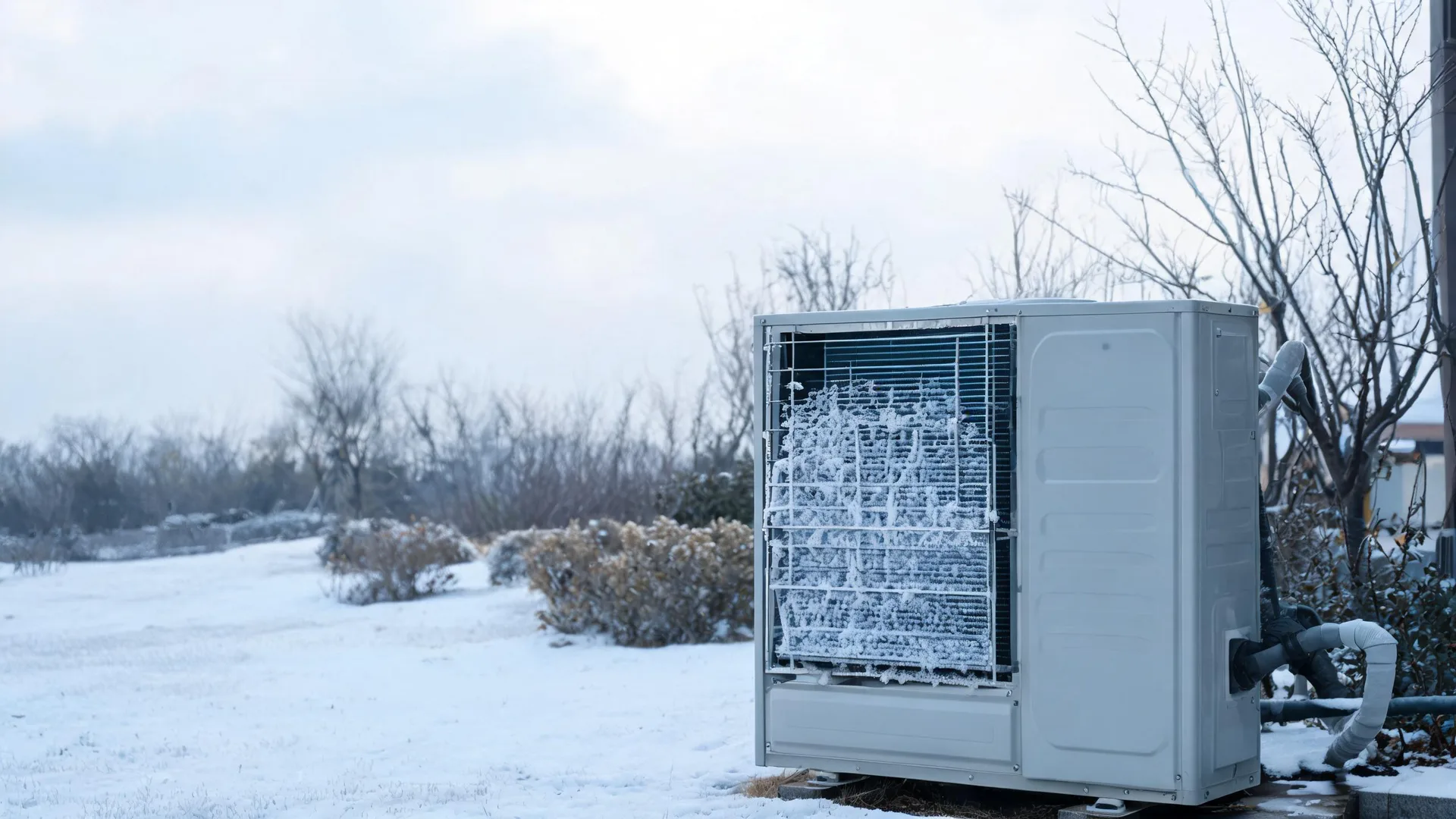
A heat pump runs the reversing valve every time it switches between heating and cooling, and that valve is a common failure point because it works all year instead of sitting idle part of it. The defrost board is another. It tells the unit when to melt frost off the outdoor coil, and when it fails the coil can ice over until the system can't pull in enough air. Capacitors wear down from just running, and a weak one shows up as a unit that hums but won't start, or a fan that spins slow. Low refrigerant charge, usually from a slow leak at a fitting or coil, makes the system run long and still fall short on output. None of these come from the machine being pushed too hard. They're what happens to a machine that cycles on and off for years.

What you'll actually notice first

A heat pump in trouble rarely just stops working. It runs longer than it used to, and the air coming out feels lukewarm instead of warm. Some homeowners hear it before they feel it. A clicking at the outdoor unit that doesn't resolve into a start, or a hum that keeps going without the fan ever kicking in. Ice building up on the outdoor coil and staying there is another one worth watching for. These signs tend to show up days before a full breakdown, not after.
Why it's worth a call at the first sign

A reversing valve or defrost board that's starting to fail doesn't usually get better on its own. Running the system hard while it struggles can turn one bad part into a frozen coil or a burnt-out compressor. Catching it early, while it's still one failing part, is what keeps a repair a repair.

A compressor that's low on charge or fighting a weak capacitor doesn't shut itself off to protect anything. It keeps running, because that's what it's built to do, and a coil that's starting to ice over doesn't stop the system either. It just makes the compressor work with less airflow every hour that ice stays on. Left alone, that's how one bad part turns into a seized compressor, which is a far bigger repair than the part that started it. Shutting the system off when you notice these signs doesn't fix anything, but it stops a failing part from taking the rest of the system down with it. That's the real reason to get it looked at as soon as something sounds or feels off, not after it quits.

Repair versus replacement comes down to one failing part against the rest of a working system. A compressor is the one part that usually decides it. If the compressor itself is bad, that's a different conversation than a bad capacitor or a stuck reversing valve, because the compressor is most of what the system costs. Everything else around it, the board, the valve, the fan motor, gets replaced on its own all the time without anyone considering a whole new unit. Age matters too, but less than people think. A system that's been kept up, with the coils clean and the refrigerant charge correct over the years, can take a part failure in stride. One that's been run hard and ignored tends to fail in more than one place around the same time, and that's when a contractor starts talking about replacing instead of repairing.