A lit brick residential street at dusk showing a row of two-story homes with covered porches and mature trees.

Heat Pump Installation in Parkville, MO

Tell us about the job

Takes about a minute. No obligation.

New system or replacementHeat PumpPlatte County, MO
Step 1 of 2

What ZIP code is the job in?

Platte County sees real weather

Platte County logged 169 severe weather events between 2015 and 2024. Most of that was wind and hail, 68 damaging wind events and 90 hail events, with one tornado in the mix. An outdoor heat pump unit sits outside through all of it.


Power doesn't always hold

Close to one in five Missouri households went at least 24 hours without power in 2024. A heat pump needs electricity to run, for heat and for cooling both, so an outage reaches further than the lights.

7 months
October through April, your system heats
5 months
May through September, it cools
22°F
the average winter night it heats against
87°F
the average summer afternoon it cools against
Isometric line illustration of a cutaway single-story house showing interior ductwork, an indoor air handler unit, and an outdoor condenser connected by refrigerant lines, with a dark shingled roof.
Your system heats October through April and cools May through September.

NOAA nClimDiv, 1991–2020 normals

Gas heats 58.1% of homes in Platte County, electricity heats 35.4%.

Most houses here already have gas furnace ductwork, and a heat pump installer will size the new system to work with it.

October through April is heat season here, so get it in before September runs out

Cooling runs May through September
Heat runs October through April
Climate zone 4A

Ninety hail events in Platte County between 2015 and 2024 is not a rare storm. That's close to one every month somewhere in the county. A heat pump's outdoor unit sits right in that path, with its coils and fan exposed to whatever falls. Summer adds its own load. The dew point here averages 65°F through June, July and August, and air that heavy makes a system run long hours just to keep a house feeling dry. Between the hail and the muggy stretch, this equipment doesn't get an easy year. Sizing it to the house, not to the lowest bid, is what keeps it standing up to both.

Plan for the outage before the installer shows up

Ask where the outdoor unit will sit and what will shield it from hail and wind. Ask what happens to heat and hot water if the power drops for a day, since a heat pump runs on electricity for both. Get those answers as part of the installation, not after the first outage.

Find a contractor
A man in a cap, gray T-shirt and tan work pants climbs porch steps toward a blue front door, carrying a canvas tool bag in his right hand, with a potted shrub in a blue planter beside the door.
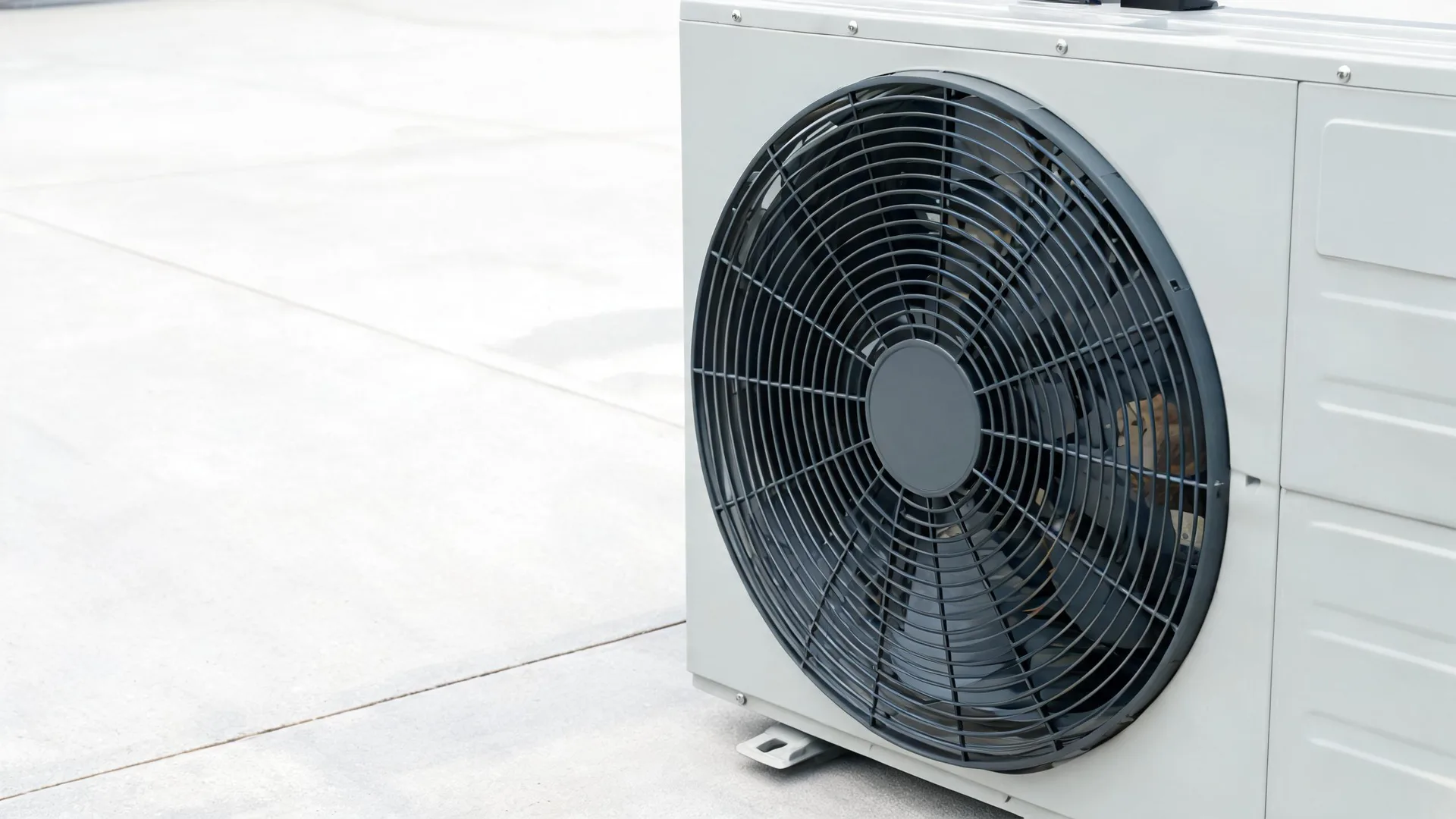
A gray outdoor HVAC unit mounted on a concrete pad beside a house with gray lap siding and a stone foundation.

This machine earns its keep here, year after year

The unit running outside this house will see every one of those ninety hail events land somewhere nearby, and it will run long hours each summer besides. That workload is the case for sizing it to the house instead of taking the lowest bid. An undersized unit just works harder in that heat, and a unit that's cheap because it skimped on the cabinet or the coil guard has less standing between itself and whatever the sky drops on it. Ask the installer to size the system off a load calculation for your house, not a square footage guess, and ask what the outdoor unit is built to take before you sign.

Ask what happens when it gets cold enough

Every heat pump loses capacity as the outdoor temperature drops, and below a certain point it needs backup heat to keep up. Ask what that backup source is, how it switches on, and whether it's sized to carry the house on its own if it has to. A system that can't answer that question clearly is one you'll be troubleshooting on the coldest night of the year.

Ask for the load calculation, not the square footage

A heat pump sized off square footage alone can end up too big or too small for the house it's in. An oversized unit short cycles, meaning it turns on and off too fast to properly dry the air or hold a steady temperature. An undersized one runs constantly and still falls behind. A proper load calculation looks at insulation, windows, and duct layout, and it's the only honest way to land on the right size.

The efficiency rating on a heat pump's label tells you how much heat or cooling it moves for the electricity it uses. A higher rated system gets more out of every hour it runs, which matters most on the days it runs longest. That rating is measured under set lab conditions, so it's a way to compare one system against another, not a promise of what you'll see on the harshest day of the year. Installation matters as much as the rating itself. A correctly charged system, with ducts that aren't leaking air out before it reaches the rooms, will get closer to its rated efficiency than the same equipment installed poorly. The rating also assumes the right size unit for the house it's heating and cooling. Pair a high efficiency rating with the wrong size equipment and you lose a good share of what that rating promised.

Platte County falls in climate zone 4A, which asks real work of a system in both directions, humid summers and cold winters both. Any split-system heat pump installed here now has to meet a federal floor, a minimum efficiency of 14.3 in summer and 7.5 in winter if it was built on or after January 1, 2023. That's not a target to aim for, it's the baseline every new unit starts from. It narrows the field some, but it also means nothing sold new today is built for a milder climate than this one actually has.