




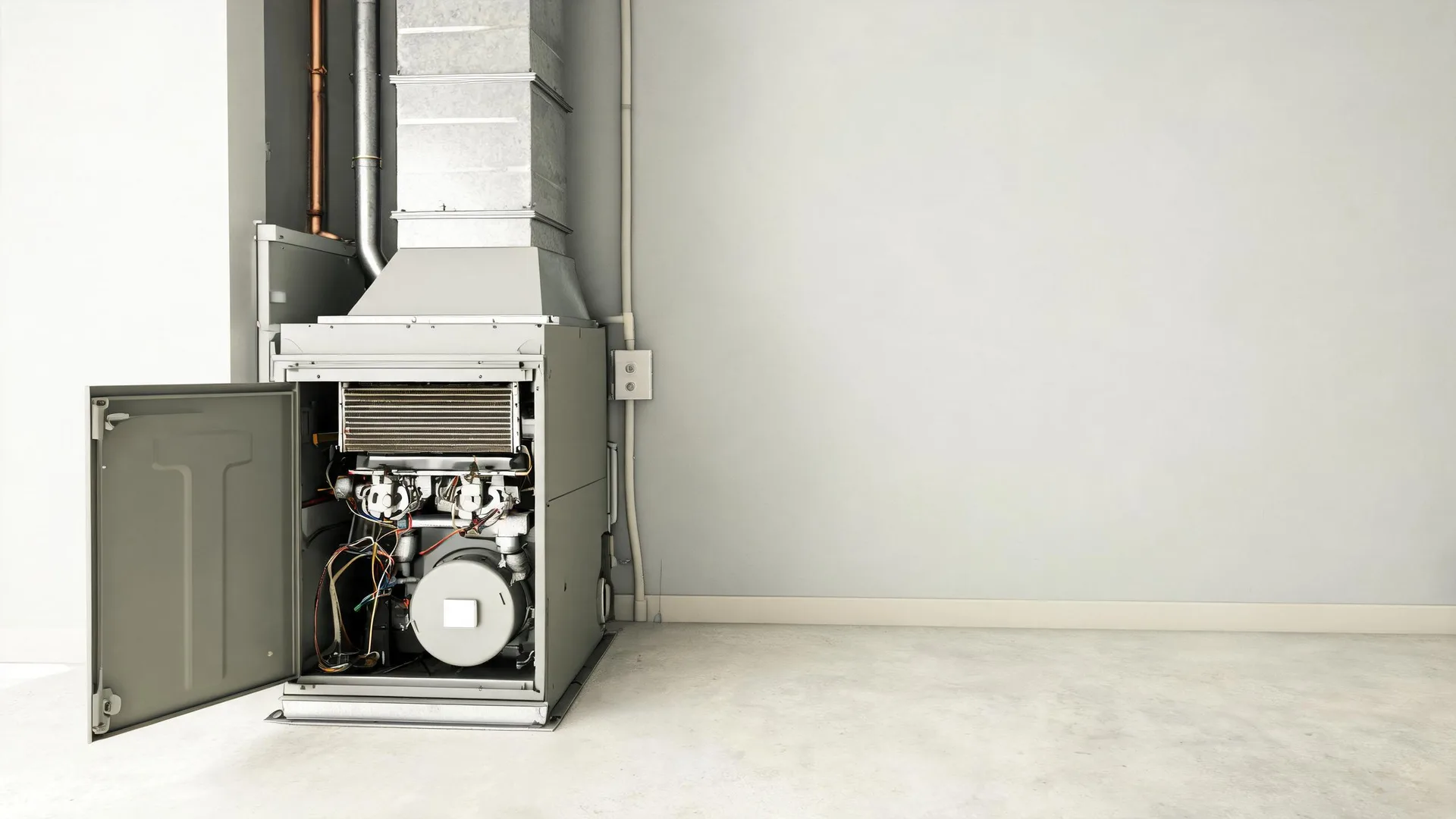
A bare concrete basement containing a gray gas furnace with metal ductwork and a vertical flue pipe, lit by a single hanging bulb.

Furnace Repair in Washington, MO

Tell us about the job

Takes about a minute. No obligation.

RepairFurnace or heatingFranklin County, MO
Step 1 of 2

What ZIP code is the job in?

September is worth a look before heat season starts in October. A furnace that sat quiet since spring will get asked to run for the next seven months straight, and whatever was already marginal in it tends to fail in the first cold snap rather than wait. A cracked igniter, a weak capacitor, a clogged filter someone forgot about since April, these don't get better sitting idle. If your furnace struggled at the start of last winter, that same weak point is still in there. Getting it looked at before October means a repair now instead of a no-heat call in the first hard freeze.

7 months
October through April, your furnace is on duty
24°F
the average winter night it heats against
9 winter storms
in ten years, the nights a failure hurts most
Isometric cutaway illustration of a house showing interior rooms with furniture, a furnace unit with a tall flue pipe outside, and ductwork running through the attic.
Your furnace works hardest from November through March.

NOAA nClimDiv, 1991–2020 normals

Furnaces in Washington run from October through April, about seven months straight.

Whatever part was already weak in spring has had all summer to fail quietly, and it picks winter to show it.

Missouri electricity runs $37.84 per million Btu, and a furnace running wrong burns that every day it's broken

Heat runs October through April
Winter nights average 24°F
Climate zone 4A

Half the homes in Franklin County were built in 1984 or later. If that's your house, the furnace in it has had less time to wear out than the age of the place might suggest, especially if it's been swapped out even once since. A furnace that age is usually still a good repair candidate. The igniter or capacitor failing isn't a sign the unit is done, it's just the one part that gave out first. Worth knowing before anyone tells you replacement is the only option.

Nothing unusual is behind this, just a part that needs finding

Franklin County gets its share of wind and hail, even the odd ice storm. None of that singles out your furnace. A system here fails for the same reason one fails anywhere. A part wore out. That's good news for a repair call. A tech is looking for one of the usual culprits, not something strange to this area, and usual problems have known fixes.

Find a contractor
A gray gas furnace with attached ductwork and piping installed in an unfinished concrete basement.

Built in 1984 or later, your furnace has fewer winters behind it

A furnace built with a newer house hasn't logged as many winters as an older one. Call someone out when it acts up and let the tech chase down the actual part at fault instead of assuming the whole unit is at the end of its life.

The igniter goes first, most often

A hot surface igniter takes a hard jolt of power every time it fires, and that cycle of heating up and cooling down is what eventually cracks it. It's a thin strip, and once it's cracked it either glows weak or doesn't glow at all. No igniter, no flame, no heat. It's one of the most common reasons a furnace won't start, and it's a straightforward swap once a tech confirms that's the part at fault.
A dirty flame sensor reads as a bigger problem than it is

The flame sensor's job is to confirm a flame is actually burning after the gas valve opens. A film of residue builds up on it over time, and once that coating is thick enough, the sensor can't tell if there's a flame or not. The furnace shuts itself down rather than risk running the gas valve with no flame to burn it. It looks like a serious fault from the thermostat, but it's usually just a sensor that needs cleaning.

Most people notice a furnace problem before they can name it. The house takes longer to warm up than it used to, or the air coming out of the vents feels cool instead of warm. Sometimes the furnace starts, runs for a minute, then shuts off on its own and tries again later. That short-cycling is usually the furnace protecting itself from something, not a random glitch. A burning smell the first few times it runs after sitting idle is normal and clears on its own. A smell that lingers, or one that's sharper and doesn't fade, is not. Listen for banging or a rhythmic clicking that wasn't there before, and watch for a pilot or flame that looks weak or yellow instead of steady blue. Any of these is worth a call before the furnace stops running altogether instead of just running wrong.

A furnace is made of parts that fail one at a time, not all at once, so the question is almost never the whole unit. It's whether the part that just failed is worth fixing on its own, and most of the time it is. Age matters less than people think. A furnace that's been maintained can take several repairs over its life and still be the cheaper path every time, because the cabinet, the heat exchanger and the blower motor are the expensive pieces, and those tend to outlast the igniters and sensors and switches that actually fail. What changes the math is a heat exchanger that's cracked, since that's a safety issue and not just a worn part, or a string of different components failing in close succession, which usually means the whole system is wearing out at once rather than one weak link giving out. Short of that, replacing a furnace over one bad part is usually spending more to solve a smaller problem.