



A quiet suburban street at twilight featuring two-story brick homes with illuminated windows and large trees lining the sidewalk.

Furnace Repair in Dexter, MO

Tell us about the job

Takes about a minute. No obligation.

RepairFurnace or heatingStoddard County, MO
Step 1 of 2

What ZIP code is the job in?

A tech starts by asking what the furnace is doing, or not doing, before anything gets opened up. Short cycling, no heat at all, a smell on startup, a noise that wasn't there before, all of that points somewhere different. From there it's a look at the igniter or pilot, the flame sensor, the blower wheel and motor, and the control board that ties them together. Most furnaces store a fault code or a pattern of light flashes that narrows things down fast, so the tech will check that before pulling anything apart. The gas line and venting get checked too, since a furnace that's unsafe to run matters more than one that's just not heating well. By the end you should know what's wrong, what it takes to fix it, and whether it's worth repairing or replacing.

7 months
October through April, your furnace is on duty
29°F
the average winter night it heats against
12 winter storms
in ten years, the nights a failure hurts most
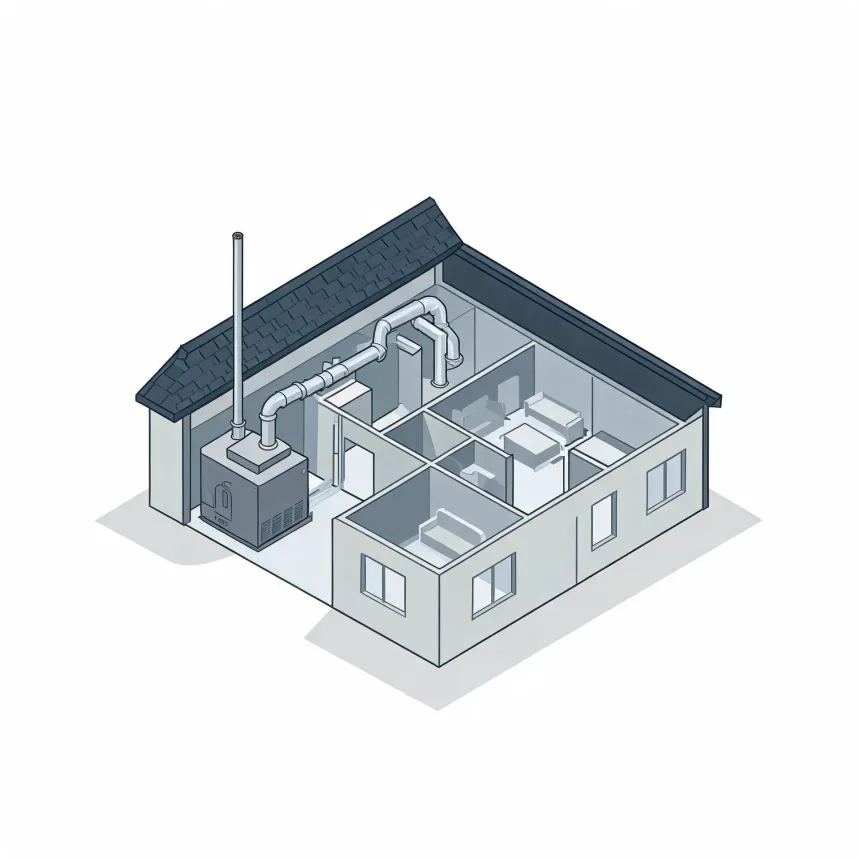
Isometric grayscale illustration of a cutaway single-story house showing interior rooms with furniture, plus an exterior furnace unit with a tall flue pipe and ducting running into the attic space.
Your furnace works hardest from November through March.

NOAA nClimDiv, 1991–2020 normals

A cracked heat exchanger or a failed control board usually means replacement, not repair.

A bad igniter or flame sensor is a straightforward fix on almost any furnace.

110 damaging wind events, 13 hail events, this furnace has to survive the storm, not just the season

143 severe weather events from 2015 to 2024
19% of homes statewide lost power a day or more in 2024
110 damaging wind events from 2015 to 2024
October asks the most of a furnace that's sat idle since springHeat starts running in October here, and that first cold snap is when a weak part usually shows itself.

A furnace usually gives some warning before it quits outright. It might take longer to kick on, or the burners light with a soft thump instead of a clean catch. The blower can start sounding different, a rattle or a hum that wasn't part of its normal cycle. Some furnaces blow air that feels cooler than it should, which often means the heat exchanger isn't transferring heat the way it used to, or the gas valve isn't opening fully. A yellow flame instead of blue is worth paying attention to, since it can point to a combustion problem rather than just wear. Short cycling, where the furnace shuts off before the house warms up, is usually the thermostat, the flame sensor, or airflow getting blocked somewhere in the system. None of these mean the furnace is done. They mean it's telling you something, and the sooner that gets looked at, the fewer parts it usually takes to fix.

Get it looked at early

Problems tend to show up in the first weeks of the season, when the load hits a part that was already weak.

Find a contractor
A man in a gray shirt and brown pants, seen from behind, carries a canvas tool bag up porch steps toward a blue front door beside a potted shrub.
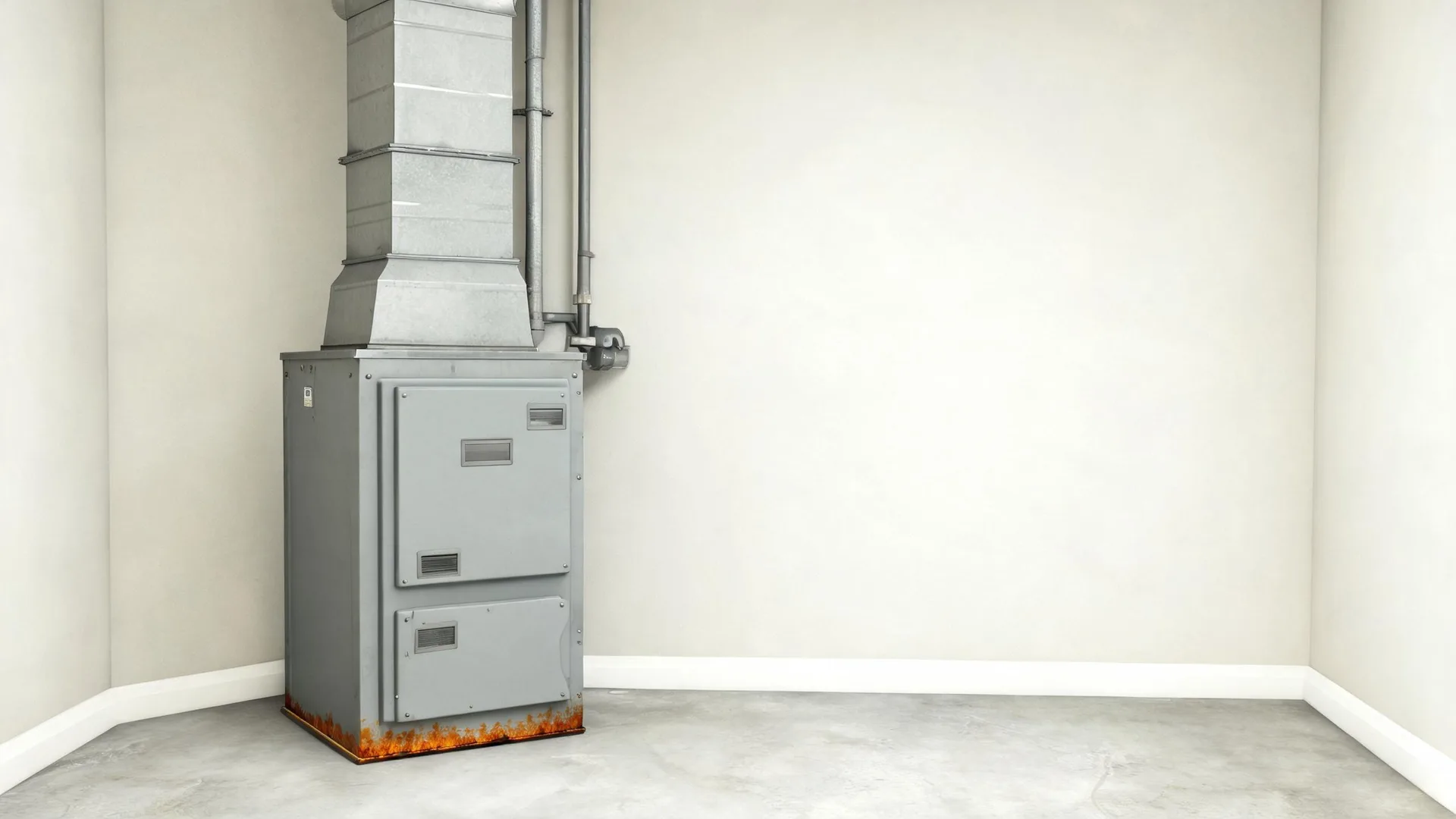
A gray gas furnace with attached ductwork and piping installed in an unfinished concrete basement.

What to check before you pick up the phone

Check the thermostat first. Make sure it's set to heat, not cool, and that the set temperature is actually above room temperature. If it runs on batteries, swap them before you do anything else. Next, look at the air filter. A filter clogged with dust chokes off airflow, and a furnace that can't breathe will often overheat and shut itself down as a safety measure. Walk around the house and check that supply vents and return grilles aren't blocked by furniture or rugs. Then go to the breaker panel and make sure the furnace's breaker hasn't tripped, and confirm the switch that looks like a light switch near the furnace, the one that kills power to it for service, is in the on position. If it's a gas furnace, check that the gas valve at the unit is turned to open. Open the furnace's front panel if you can do it without tools, since many furnaces have a safety switch on that panel that has to be fully seated for the unit to run at all. None of this is risky, and none of it requires taking anything apart. If the furnace still won't run after that, or it runs but something about it seems off, that's the point to stop and call someone.

Have the outdoor parts checked after a bad storm

If hail or wind debris hit the system, get the outdoor unit inspected even if the furnace is still heating fine. A bent cabinet or damaged wiring from a storm doesn't always show up as a problem right away.
Ask about battery backup for the controls

A furnace with an electronic control board won't fire without power, no matter how cold it is outside. Some setups can keep the board and ignition running through a cut. Worth asking a contractor what your system supports.

Running a furnace with a problem instead of shutting it down and calling someone usually costs more than the original fault. A cracked heat exchanger starts small, and heat keeps stressing the crack wider every cycle it runs. A flame sensor coated with a thin layer of oxidation might still let the furnace fire, just weakly, and each cycle on a dirty sensor leaves more buildup behind. A blower motor that's starting to seize will draw more current trying to spin, and that heat has nowhere to go but into the motor windings. Even something as simple as a clogged filter forces the heat exchanger to run hotter than it's built for, and metal that keeps overheating fatigues faster. The furnace isn't being stubborn when it keeps running rough. It's a sign that something is already failing, and continuing to run it pushes a repair toward a replacement.

Most furnace failures trace back to a handful of parts, and they tend to fail for reasons that build up over time rather than all at once. Igniters are brittle, and they weaken with every heat and cool cycle until one day they don't get hot enough to light the gas. Flame sensors fail by coating, a thin layer of oxidation building up on the rod until it can no longer sense the flame and tells the control board to shut things down. Blower motors wear at the bearings, and a motor working harder than it should runs hotter, which shortens its life further. Control boards fail from age, from power surges, or from moisture getting somewhere it shouldn't, and once a board starts misreading its sensors the furnace can act unpredictable in ways that look like other problems. A dirty filter isn't a failure on its own, but it's often the reason something else failed, since restricted airflow overheats parts that were only ever built to handle normal heat.