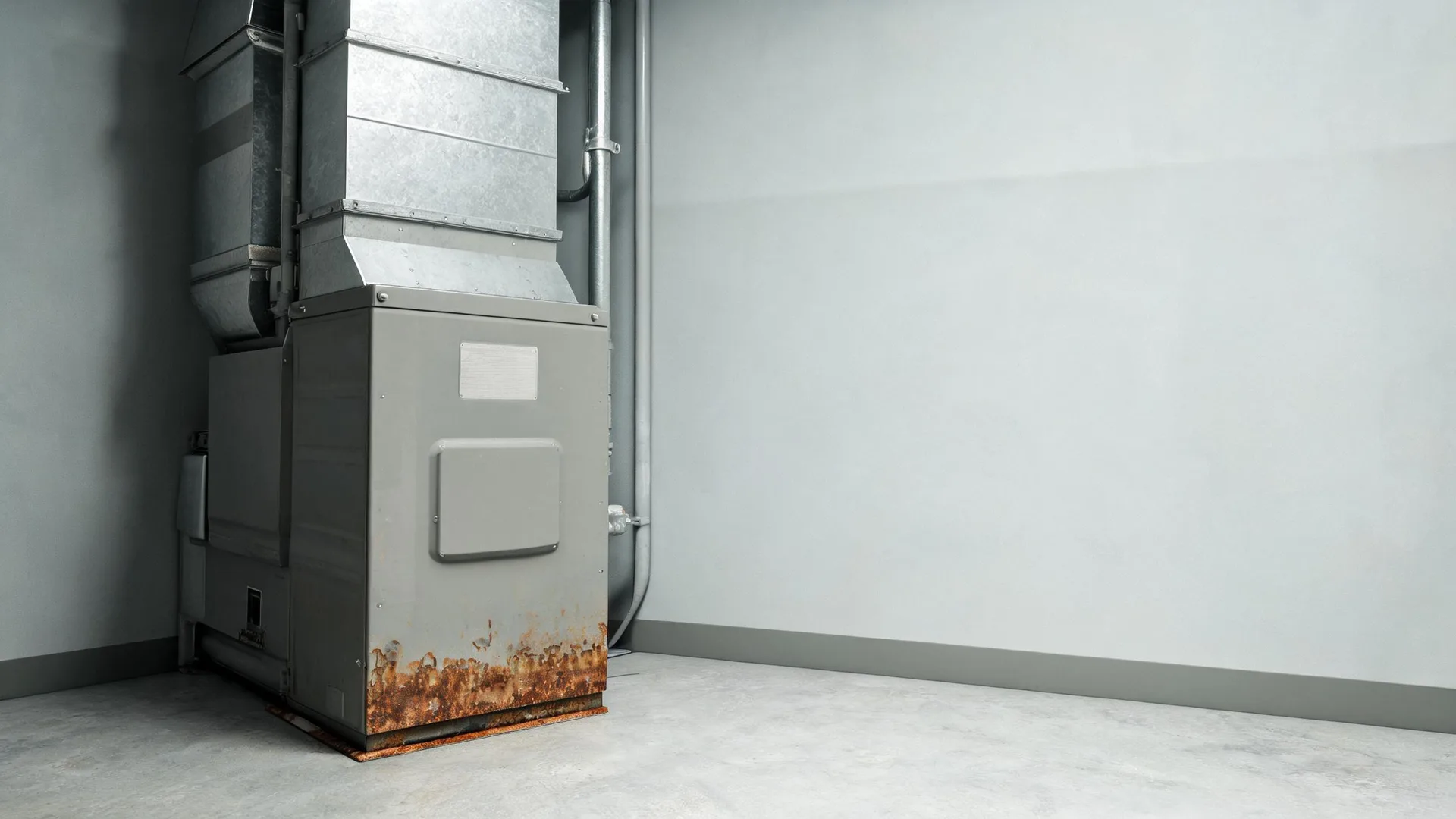
Stone County sees its share of storms
Stone County logged 190 severe weather events between 2015 and 2024, including 100 damaging wind events, 68 hail events and 8 tornadoes. Winter added 11 more, with ice and heavy snow.
Takes about a minute. No obligation.
Stone County logged 190 severe weather events between 2015 and 2024, including 100 damaging wind events, 68 hail events and 8 tornadoes. Winter added 11 more, with ice and heavy snow.
A furnace's outdoor components sit through whatever the weather brings. Hail dents a cabinet and bends fins. Wind throws branches and debris into it. If a storm came through and your furnace took a hit, that's worth having a contractor look at even if it still runs.
NOAA nClimDiv, 1991–2020 normals
A furnace won't tell you what's wrong before it quits on you.
Check the thermostat, the filter and the switch before you pick up the phone.



If your furnace came with the house and the house was built in 1992 or later, you're not dealing with equipment near the end of its life. A repair makes sense here. Get the part replaced or the control fixed rather than treating the call as a sign you need a new unit. Check the age if you can, since a furnace that's been swapped out since the house was built is a different story than the original equipment. Either way, a contractor can tell you what shape it's really in once they're looking at it.
Hail and wind don't always leave a mark you can see from the ground. If your furnace took a hit this year, get a contractor to look it over even if it's still heating fine.
Find a contractorA cracked heat exchanger is the clearest case. Keep running a furnace with a crack in it and the metal flexes under heat, the crack opens wider, and combustion gas finds its way into the air the blower moves through the house. A flame sensor going bad works the same way in miniature. It still catches the flame most cycles, so the furnace keeps firing, but each lockout stresses the ignition system a little more until the igniter or the control board goes with it. A blower motor running on a worn bearing will grind, then seize, and when it seizes the heat has nowhere to go but back against the exchanger. Short cycling does its own damage. A furnace that fires, trips off, and fires again puts more wear on the igniter and the gas valve each hour than one that runs a full normal cycle. None of this means shut it off at the first odd noise. It means a furnace that's acting up and still running is usually telling you to get it looked at now, while the fix is still a part and not the whole unit.
Most of the time it gives you a string of small complaints first. Short cycles that don't warm the house. A burner that takes two or three tries to light. A blower that runs on after the heat shuts off, or won't stop at all. Cold air coming out of some vents and not others. Any one of these is a part wearing down, not the whole system failing at once.
A burner flame that's yellow or flickering instead of steady blue points to a combustion problem. So does soot around the cabinet, a burning smell that doesn't fade after the first few minutes of a cycle, or a headache that shows up when the furnace runs and clears when you're outside. Those aren't wait-and-see signs. They mean shut it off and get a contractor out before you run it again.
Furnaces usually fail one part at a time, and most of those parts fail in predictable ways. An igniter weakens with each cycle until it stops glowing hot enough to light the gas. A flame sensor coated with a thin layer of oxidation stops sensing the flame that's right in front of it, so the control board shuts the gas off as a safety measure. Blower motors wear out at the bearing, and you'll hear it grind before you ever see it quit. A control board can fail outright, or it can develop a bad relay that only shows up as an intermittent no-heat call. Flame sensors and igniters are routine wear parts. A cracked heat exchanger or a failed control board are not, and those point to a bigger repair. What matters is catching the small failures while they're still small, because a furnace limping along on a weak igniter or a dirty sensor is still putting full wear on everything else it runs.
A diagnostic visit starts before the furnace is ever opened up. A contractor will ask what you've noticed: when it happens, whether it's every cycle or just some, what the air smells or sounds like. That narrows down what to check first. From there they'll run the furnace through a cycle and watch it, since some problems only show up while it's firing or shutting down, not while it sits cold. They'll check the flame, pull the panel and look at the igniter or sensor, test the blower and check the pressures on the gas side. A combustion analyzer can measure what's actually coming out of the exchanger, which tells you whether gas is burning clean or something's off even if the flame looks normal. By the end they can usually point to the one part that's failing and tell you what it'll take to fix it, rather than guessing at the whole system.