
A row of dark-sided single-story cottages with brown shingled gable roofs behind trimmed hedges, mown lawn and a light-colored path, surrounded by large deciduous trees under an overcast sky.

Furnace Maintenance in Odessa, MO

Tell us about the job

Takes about a minute. No obligation.

Tune-up, service, or cleaningFurnace or heatingLafayette County, MO
Step 1 of 2

What ZIP code is the job in?

Furnace here runs from October through April, about seven months straight. Once a year, before that stretch starts, is enough. The overnight low averages 23°F across December, January and February, and that's when a weak igniter or a cracked heat exchanger turns into a cold house instead of a minor fault code. A check in early fall catches that while there's still time to fix it without scrambling. There's nothing about Odessa that wears a furnace down faster than anywhere else. It's the same machine doing the same job, so it needs the same yearly look, timed to land before the cold does.

Furnace in Odessa starts its seven-month run in October.

Get it checked in September, before it has to work.

Over half the homes in Lafayette County heat with gas

50.9% of homes heat with gas
Heat runs October through April
Winter nights average 23°F

Half the homes in Lafayette County were built in 1975 or earlier, half more recently than that. The furnace in either one could have been installed last year or a decade ago. There's no way to tell from the house's age alone. What doesn't change is the once a year check before the cold sets in. An older unit and a newer one both need the same yearly look, because wear doesn't care how old the house around it is. If the furnace came with the house, that's worth asking about when it's time to have it looked at.

One check this fall is the whole job

Gas here ran $16.49 per million Btu last year. A furnace that's skipped its yearly check has to work harder to push heat through the house, and that shows up on the gas bill before anything else gives out. One visit in the fall is the whole job, done before the cold sets in.

Find a contractor
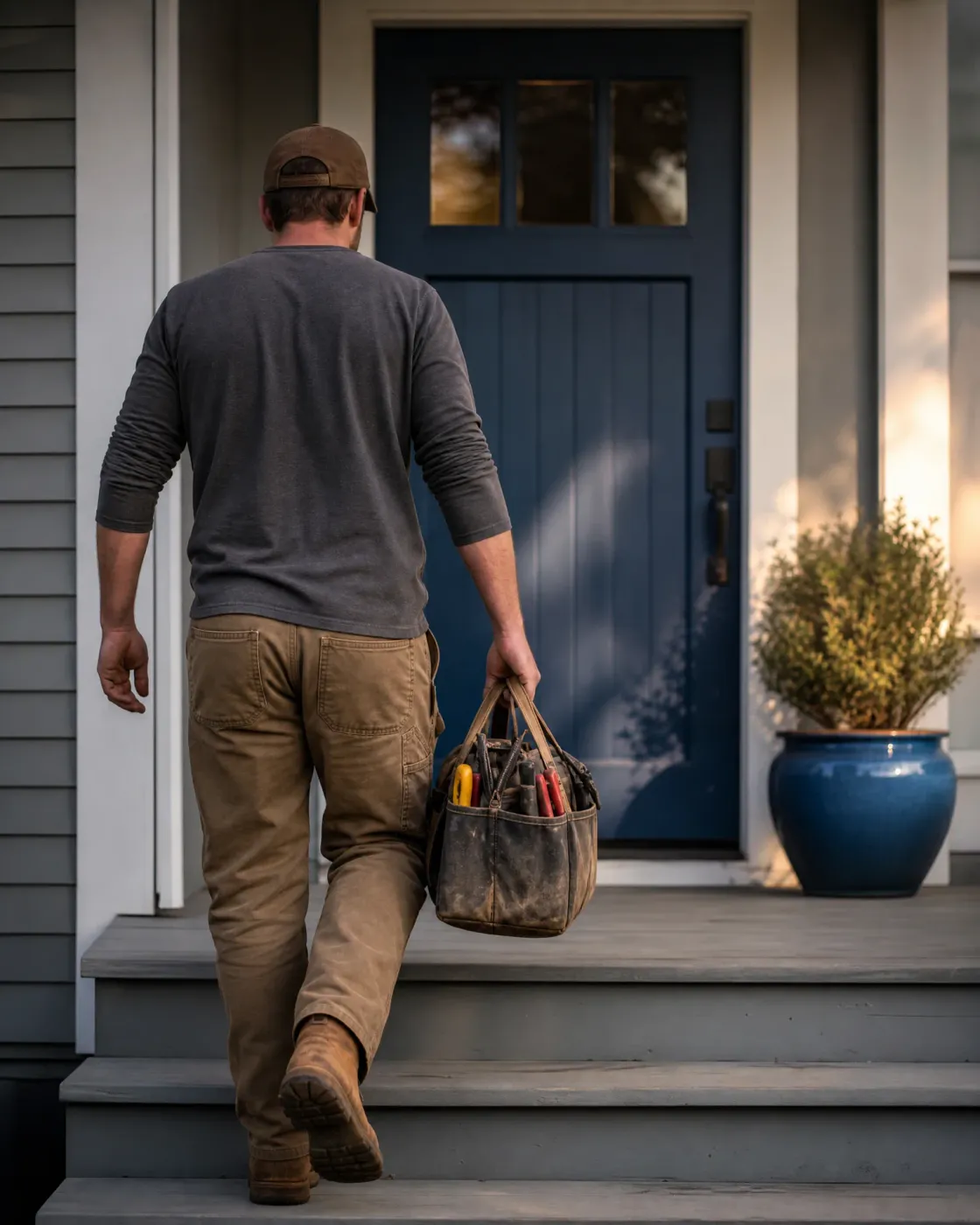
A man in a cap, gray long-sleeve shirt and tan work pants carries a canvas tool bag up gray porch steps toward a dark blue front door, with a blue ceramic planter and shrub beside it.
A gray gas furnace with attached ductwork and piping installed in an unfinished concrete basement.

What to do in between, and what to leave alone

The filter is the one thing worth checking between visits. A dirty filter chokes airflow, and a furnace starved for air runs longer and hotter than it should. Hold it up to a light. If you can't see light through it, swap it. Keep the vents and the return grille clear of furniture and rugs so air can actually get where it's going. Walk past the unit now and then and listen. A new rattle, a hum that wasn't there before, a burning smell, any of those is worth a call before it turns into a cold house. Past that, leave it alone. The burners, the igniter, the heat exchanger, the flue, those aren't things to open up or test yourself. That's what the yearly check is for.

What's under the burners

Flame should burn blue and steady. A yellow or flickering flame can mean the burner is dirty or not getting enough air, and that's something you'd have to pull the panel and watch it run to catch. Left alone, a bad burn pattern means the furnace isn't turning all the gas into heat, and some of what it's burning isn't going where it should.

Checking the exchanger for cracks

The heat exchanger sits behind the burners and never shows itself during normal use. A hairline crack in it lets combustion gas mix into the air your ducts carry through the house, and there's no sound or smell that reliably warns you before a technician finds it with a light and a mirror. This is the main reason the yearly check isn't optional.

A quick visit means someone swaps the filter, glances at the flame, and calls it done. A thorough one means the panels come off. The burners get pulled and cleaned, not just looked at, because dust changes how they burn even when the flame looks fine from a distance. The flue gets checked for a solid connection all the way out, not just a glance at the pipe. Amp draw on the blower motor gets tested against what that motor is supposed to pull, since a motor can run while it's already failing. The heat exchanger gets the light and mirror, not a guess based on the furnace's age. If the visit takes less time than it takes to explain what got checked, most of this list didn't happen.

A proper tune-up starts with the furnace running, not off. A tech wants to see the flame, hear the blower, feel what the air's doing at the register before anything gets touched. The igniter gets tested under load, since a glow plug or hot surface igniter can look fine sitting still and still fail to hold up once it's cycled a few times. Gas pressure gets checked at the manifold and set to what the furnace is built for, not left wherever the last person set it. The inducer motor and the blower both get checked for play in the bearings, because a bearing going bad makes noise long before it seizes. Every wire connection at the control board gets snugged down, since a loose one is a common reason a furnace stops mid-cycle for no obvious reason. Safety switches, the ones that shut the furnace down if it overheats or the flame fails to light, get tested to make sure they actually trip when they're supposed to, not just that they're present.