





An unfinished basement interior showing a gray furnace unit beneath a bare incandescent bulb, surrounded by exposed joists, concrete walls, cardboard boxes, and utility pipes.

Furnace Maintenance in Hannibal, MO

Tell us about the job

Takes about a minute. No obligation.

Tune-up, service, or cleaningFurnace or heatingMarion County, MO
Step 1 of 2

What ZIP code is the job in?

Furnaces in Marion County start running in October and stay on through April. That's seven months of the year this system can't take a day off. September is the month to get it checked, before it has to carry that load. A tech can catch a weak igniter or a cracked heat exchanger while the furnace is still sitting idle, not after it's been firing every night for weeks. Wait until October and you're booking the check at the same time the furnace is already working hard.

Furnace maintenance here is a once-a-year job.

Get it done before October and that's one less thing to think about until spring.

One check before October covers you through April

Heat runs October through April
Winter nights average 22°F
Climate zone 5A
Older homes mean older furnacesHalf the homes in Marion County were built in 1971 or earlier.

Most homes in Marion County heat with gas, 55.2 percent, and another 11.4 percent run on LP. A gas or LP furnace needs more than a filter swap. The burner has to be checked for a clean, even flame, the venting has to be clear so exhaust actually leaves the house, and the safety controls that shut things down if something goes wrong need to be tested while the furnace is off, not guessed at later. Electric furnaces, the rest of the homes here, don't carry that risk, but the blower and coil still need a look before cold weather asks something of them.

If your furnace is as old as your house, get it checked every year

A furnace that's been there as long as the house has had plenty of time to develop a small problem. A yearly check is how it gets caught while it's still small.

Find a contractor
A man in a gray T-shirt and tan work pants, seen from behind, carries a worn canvas tool bag up concrete steps toward a blue front door of a house with gray siding and a potted shrub.
A gray high-efficiency gas furnace installed in an unfinished basement, surrounded by gas lines, a condensate drain, and sheet-metal ductwork.

What a real tune-up actually touches

A quick visit gets you a new filter and a look at the thermostat. A thorough one gets the furnace apart. The tech pulls the burner assembly and checks the flame, not just that it lights, but that it burns even and blue across every port. The heat exchanger gets inspected for cracks, which means a flashlight and a mirror, not a glance. Amp draw on the blower motor gets tested against what it should be pulling, not just listened to for noise. The flue and venting get checked for a solid connection the whole way out, since a loose joint there is the kind of thing that doesn't show up until it matters. None of that takes long to describe, but it takes real time to do. If the furnace gets opened up, something gets measured, and a reason comes with whatever the tech finds, that's the real check.

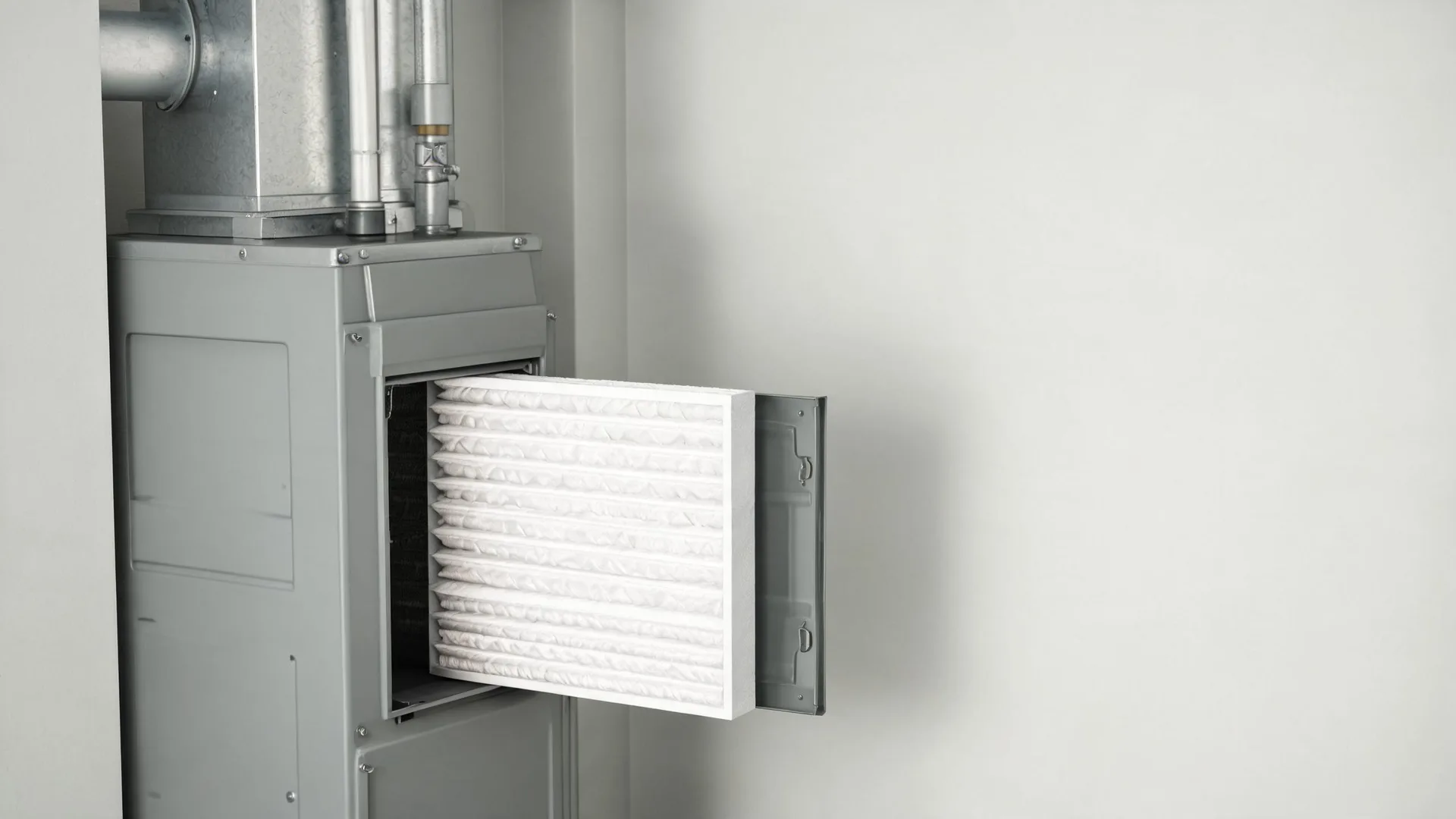
Change the filter yourself

A dirty filter chokes airflow across the heat exchanger, and that makes the furnace run longer to do the same job. Check it by holding it up to a light. If you can't see light through it, swap it. You don't need a tech for this one, and the furnace runs easier because of it.
Know what to leave alone

The burner, the flame sensor, the heat exchanger and anything behind the access panel with wires attached are not homeowner jobs. Opening that up without the right tools can knock something out of position that was set correctly, or miss a crack that only shows up under a light at the right angle. Keep the area around the furnace clear, listen for new noises, and let the rest wait for the person who does this for a living.

A dirty filter does more than choke airflow. It lets dust load onto the blower wheel and the coil behind it, and once that dust is packed on, it acts like insulation and keeps the heat exchanger from giving up its heat the way it should. On a gas furnace there's also a drain to think about if it's a high-efficiency model, the kind that condenses exhaust into water instead of sending it all out the flue as gas. That drain line can grow a clog same as any other, and when it backs up the furnace is built to shut itself down rather than let water go where it shouldn't. A furnace that won't start sometimes isn't broken at all. It's just doing what it's supposed to do when a filter, a coil or a drain hasn't been looked at in a while.

A tune-up also covers things that have nothing to do with the burner. The igniter gets tested, not just looked at, because an igniter can glow and still fail to light the gas reliably. The blower wheel comes out from under the coil if it's packed with dust, since a loaded wheel moves less air no matter how strong the motor is. Electrical connections get checked for anything loose or starting to corrode, because a bad connection generates its own heat over time. The gas pressure gets measured at the manifold and adjusted if it's drifted off spec, since too much or too little changes how the flame burns. A tune-up that skips these and just swaps the filter isn't covering the furnace, just the part of it that's easiest to reach.